
Becky Falls, Aerochrome, and a Day That Was Never About the Photos
There are some days you don’t plan for photography.
Not because you don’t want to take photos, but because the reason for the day sits somewhere else entirely. A year on, we needed to be somewhere together. Not to do anything in particular. Not to chase anything. Just to be.
The original plan had been the coast. It usually is. But the tide had other ideas, and rather than force it, we changed direction. Becky Falls made sense—close enough to where we were heading for lunch in Widecombe-in-the-Moor, easy to get to, and somewhere none of us had really explored properly before.
It also came with its own limitations.
Becky Falls is only open between 10:00 and 17:00. Not exactly prime time for photography. By the time we arrived, the sun was already high, cutting hard light through the trees and bouncing it off the granite. It was contrasty. Unforgiving. The kind of light that normally tells you to leave the camera in the bag.
But that didn’t matter.
A Different Kind of Day
The feeling in the car on the way there wasn’t sad, but it wasn’t light either. Reflective is probably the closest word. Quiet. The sort of quiet that doesn’t need filling.
And that carried through the day.
I didn’t switch into photographer mode. Not properly. There was no tripod, no filters, no intention of crafting anything. Just the GFX100S in hand, and the occasional frame taken here and there as we walked. Casual. Almost absent-minded.
And the photos reflected that.
Becky Falls itself was better than expected. We more or less had the place to ourselves, which is rare. In season, I imagine it feels very different. But on that day, it felt open. Still. The sound of water moving through rocks, the kind of constant background noise that somehow quietens everything else.
It’s a photogenic place. That wasn’t the problem.
The light was.
When the Conditions Say “Don’t Bother”
If I’d gone there purely for photography, I probably would have walked away with very little.
Harsh overhead sun. Bright highlights on water. Deep shadows between the rocks. No real shape to the light, just contrast. It flattens things out in a way that’s hard to recover, even with a sensor like the GFX.
I shot anyway, but without intention.
No careful compositions. No waiting for moments. Just fragments—rocks, water, trees. The sort of images you take because you’re there, not because you expect anything from them.
When I got them onto the computer later, they were exactly what I expected.
Fine.
Nothing wrong with them. But nothing that held attention either. The kind of images that sit somewhere between documentation and habit.
I briefly considered black and white. It’s usually my fallback when light doesn’t cooperate. Strip it back, focus on form, remove the distraction of colour.
But this time, it didn’t feel right.
The Shift
Instead, I went in a completely different direction.
Aerochrome.
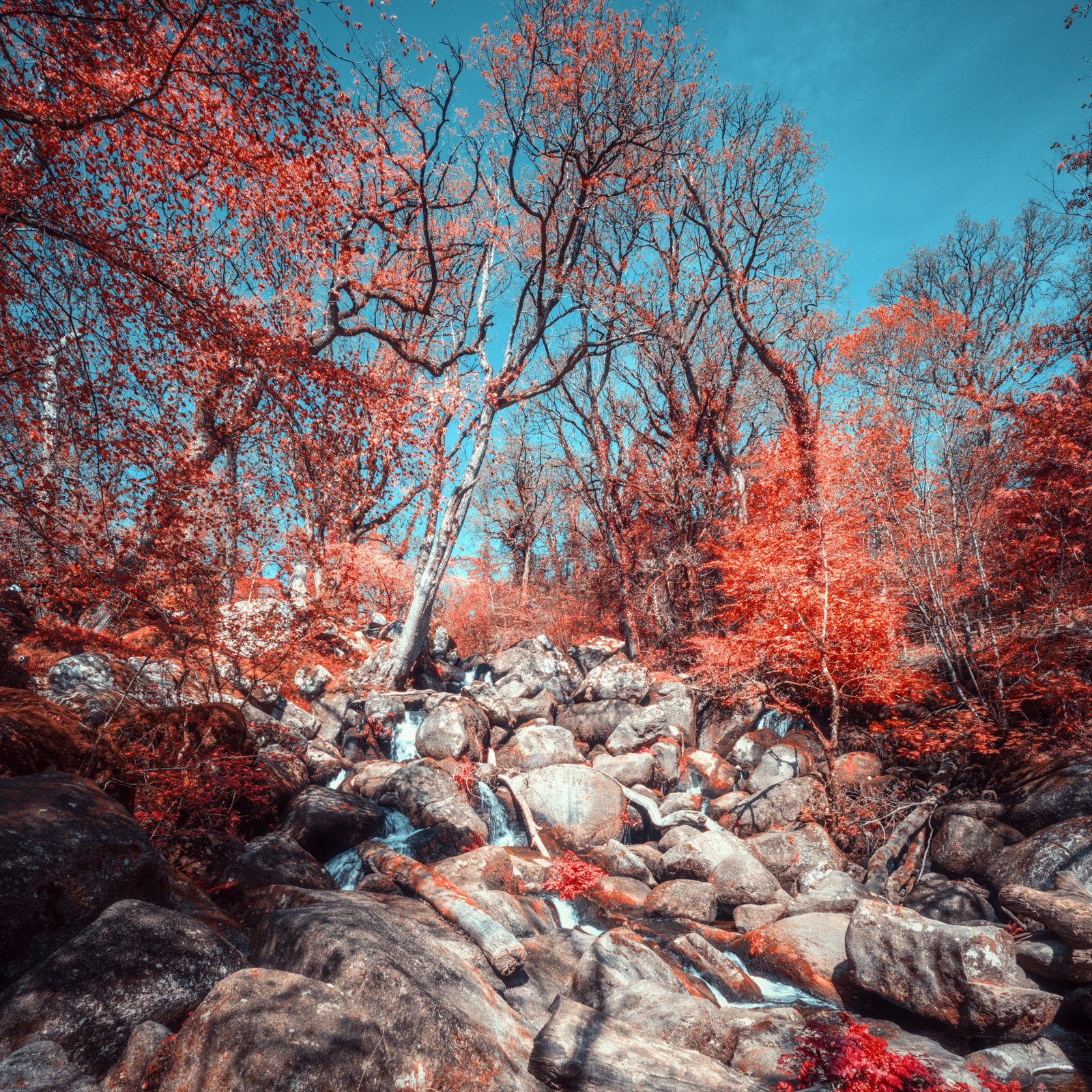
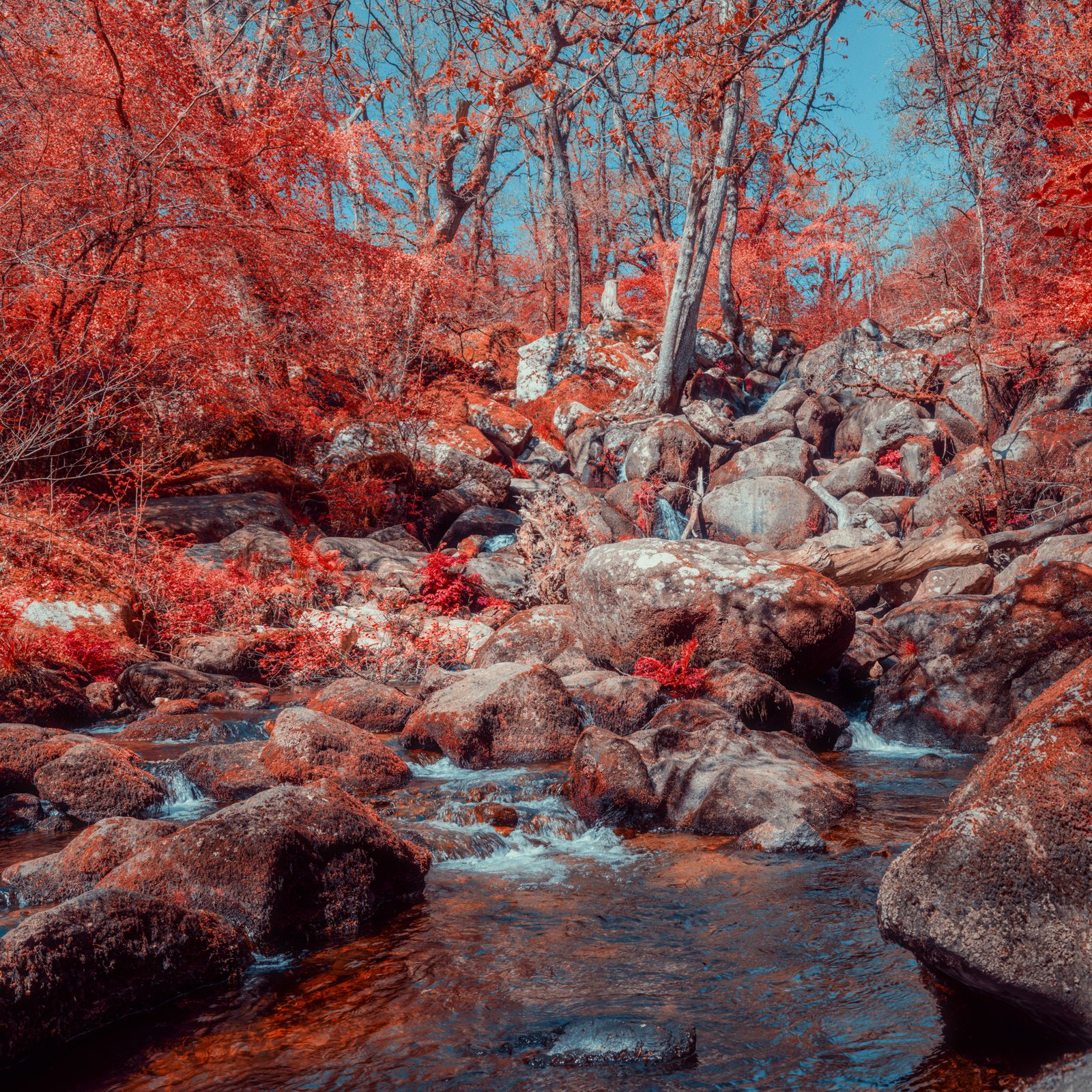
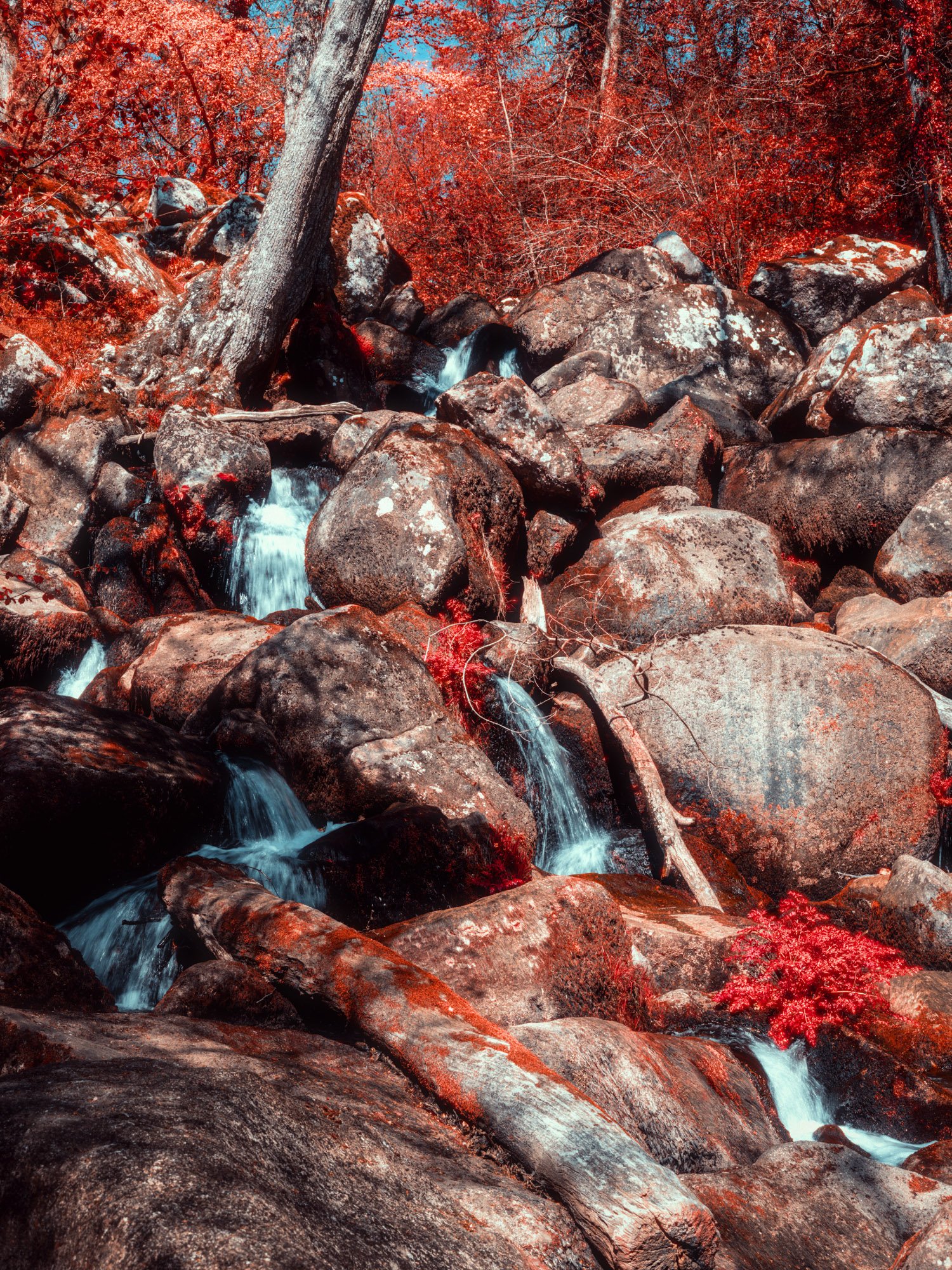
Not real Aerochrome, obviously—but an emulation, using the RNI profile pack, followed by a pass through Dehancer Pro. I leaned into an Ektachrome-style base, added halation, a touch of bloom, and let the colour do the work.
It made sense almost immediately.
The scene had all the right ingredients: rock, water, blue sky, and strongly lit foliage. The sun had been behind me for most of the walk, which meant the leaves were catching light in a way that translated perfectly into that magenta shift.
Where the original images felt flat, the Aerochrome versions felt alive.
Not realistic. But not disconnected either.
Real, But Not Quite
What surprised me most was how familiar it felt.
The magenta foliage against the turquoise-blue sky shouldn’t work. On paper, it’s unnatural. But visually, it taps into something that feels oddly nostalgic.
It reminded me of old colour photographs from the 60s and 70s—the kind where the dyes have shifted slightly over time. Skies that lean towards cyan. Colours that feel just a fraction off, but in a way that adds character rather than distraction.
There’s also something else in there. Something harder to pin down.
Maybe it’s old science fiction films. Maybe it’s faded Americana—motels in their heyday, sun-bleached signage, colours pushed just beyond where they should be. Whatever it is, the images don’t feel modern. They feel displaced.
And that’s what makes them work.
They sit somewhere between reality and interpretation. Recognisable, but altered. Familiar, but just far enough removed to make you look twice.
Seeing Differently
In a way, it’s not that different from black and white.
Black and white removes colour to simplify a scene. Aerochrome-style processing does almost the opposite—it reassigns colour, reshapes it, and in doing so, forces you to see the scene differently.
It’s not about accuracy.
It’s about interpretation.
And for me, that’s where it becomes interesting. Not as a one-off experiment, but as a way of working. A different lens, not physically, but visually. Something that changes how I approach a scene before I even press the shutter.
I can see this becoming a direction.
Rocks. Water. Blue sky. Foliage. Shot with the sun behind me. Simple ingredients, but with the potential to create something that feels just slightly other-worldly.
Not in an over-processed, digital way.
But in a way that feels considered. Intentional.
The Day, Revisited
Looking back at the images now, they don’t feel like casual snapshots anymore.
They feel like something else entirely.
And yet, the day itself hasn’t changed.
It was never about the photos.
It was about being somewhere together. About marking a moment without making a performance of it. No big gestures. No need to explain anything. Just time, shared quietly.
The photography came afterwards.
Reinterpreted. Reworked. Given a different kind of meaning through process rather than intention.
After the Fact
Sometimes the images only make sense afterwards.
When you’re out there, you don’t always know what you’re creating. Especially on days like that. The camera is just there, almost incidental.
But later, when you sit down and look at what you’ve brought back, something shifts.
A different edit. A different approach. A willingness to push something in a direction you might not have considered at the time.
And suddenly, those “just okay” images become something else.
Something that holds your attention.
Something that feels worth keeping.
Closing Thoughts
It’s easy to think of photography as something you control. Plan the location. Wait for the light. Execute the shot.
But not every image comes from that place.
Sometimes the conditions are wrong. The light is harsh. The mindset isn’t focused. The intention isn’t even there.
And yet, something still emerges.
A difficult day. Unphotographable light.
And somehow… this is what came out of it.
0 Comments