
Bluebell Photography: Capturing Calm in a Chaotic Woodland
After a long break from photography, I finally got back out to capture bluebells in a local woodland. Armed with a new notebook to jot down creative ideas — like "chaos and simplicity" — and my Fujifilm GFX100S II, I focused on simplifying dense, chaotic scenes using thoughtful crops like panoramic and square formats. It reminded me how important both the process and the right gear are. A week earlier, I saw stunning bluebells in Oxfordshire but only had my phone — and it just didn’t cut it. The right camera really does matter. This outing reignited my love for slow, intentional photography.
Back Among the Bluebells: Finding Calm in the Chaos
I haven’t been out with my camera for ages. Life gets in the way, doesn’t it? Work piles up, the weather doesn’t cooperate, and sometimes, the motivation just isn’t there. But this week, I finally carved out a few hours and made time to head out in search of bluebells. It felt like a long-overdue catch-up with an old friend. The sort of outing that reminds you why you picked up a camera in the first place.
The air was fresh, the birds were singing, and even though the light wasn’t perfect — a mix of cloud cover and sunbursts — I didn’t mind in the slightest. I was just glad to be out there again, surrounded by the hum of spring, camera in hand.
This year, I’ve added something new to my kit bag. Not a lens or a tripod — just a small, scruffy-looking notebook.
It might seem like an odd piece of gear to get excited about, but for me, it’s become essential. I use it to jot down ideas, themes, and observations while I’m in the field. It’s less of a technical checklist and more of a creative sketchpad — a space where I can explore thoughts freely. Sometimes, it’s just a word or two that captures a feeling. Other times, it’s a rough composition or a reminder to revisit a spot at a different time of day.
For this outing, I wrote down two words as soon as I stepped into the woods: chaos and simplicity.
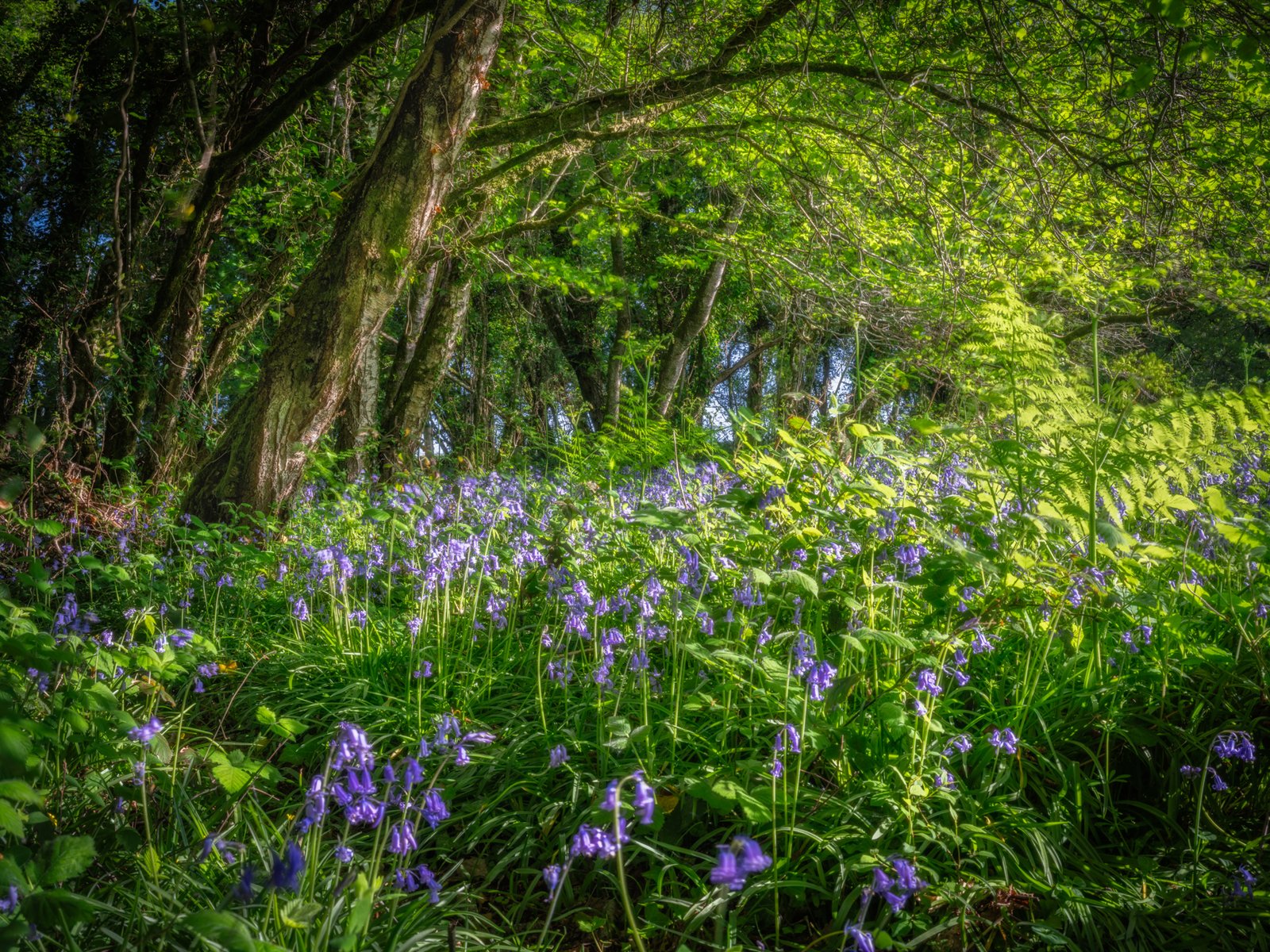
I was in a dense Devon woodland, and like many British woods in spring, it was an unruly tangle. Tall trunks twisted skyward, branches criss-crossed above, and everywhere I looked, the forest floor shimmered with bluebells. It was beautiful — absolutely — but also overwhelming. The kind of scene that looks enchanting to the eye, but can quickly turn to mush when seen through a viewfinder.
That’s where the words came in. Chaos and simplicity. My aim was to distil the woodland’s visual overload into something more digestible, more structured. Not to fight the chaos entirely, but to bring out the calm within it.
One of the key ways I approached this was through cropping and composition. I’m using the Fujifilm GFX100S II at the moment, and it’s an absolute joy for this kind of work. The dynamic range and detail it offers are outstanding, of course, but what really helped me on this outing was the flexibility of composing on such a large sensor.
I leaned into two aspect ratios in particular: the 65:24 panoramic crop — reminiscent of the classic Hasselblad XPan format — and the 1:1 square crop. The panoramic format let me create layered compositions by isolating the forest into horizontal bands: the dense bluebell carpet, the vertical rhythm of trunks, and then just a hint of canopy at the top. It’s a format that forces you to simplify, and that constraint actually made it easier to find strong compositions amid the chaos.

Bluebells in Andrews Wood Nature Reserve, Devon (65:24 XPan Crop)
In this panoramic image, a carpet of vibrant bluebells stretches across the forest floor of Andrews Wood Nature Reserve in Devon. Sunlight filters through the canopy, casting dappled light on the delicate blooms and moss-covered tree trunks. This 65:24 XPan crop captures the sense of depth and tranquility within the woodland, highlighting the enchanting interplay of light and shadow among the bluebells.
The square crop, on the other hand, encouraged a different kind of seeing. It’s ideal for focusing on lone trees, small groupings, or interesting shapes in the undergrowth. It’s also a wonderfully meditative format — very balanced, very calm — and that matched my mindset perfectly.

One thing I’ve learned over the years is that less is often more. In a chaotic environment, it’s not about cramming everything in — it’s about subtracting until the image breathes.
I didn’t rush. I wandered slowly, tried different angles, changed lenses occasionally, and paused often. The light kept shifting, which sometimes added to the difficulty — patches of harsh sun would suddenly break through the clouds — but it also offered moments of magic when soft diffused light gave everything a gentle, painterly glow.
And I suppose that’s the other side of bluebell photography. It’s not just about finding the flowers. It’s about waiting for the right light, simplifying the scene, and connecting with the space around you. I came home with a few images I really liked. Maybe not portfolio pieces, but they made me happy. And that, to me, is a success.
Just a week earlier, I’d been in Oxfordshire, passing through some stunning woodlands absolutely bursting with bluebells. They were everywhere — thick carpets of violet under ancient oaks and beech, with the late afternoon light filtering through like something out of a storybook.
And what did I have with me? My phone. And not even a good one.
Now, I know people love to say, “The best camera is the one you have with you.” It’s a well-worn phrase in the photography world. I get the spirit behind it — it's better to capture something than nothing at all. But I’ll be honest: bollocks.
That afternoon in Oxfordshire, I stood in one of the most beautiful bluebell woods I’ve ever seen, and I felt utterly frustrated. My phone’s camera couldn’t handle the light. The dynamic range was awful. The detail was mush. And worst of all, I didn’t feel connected to the process. There was no joy in composing, no satisfaction in the shutter click. It was just… meh.
If I’d had the Fujifilm or even my Nikon Z50 II, I’d have been in heaven. I don’t need perfection — I just want the tools that let me interpret a scene in the way I see it. That give me control. That let me slow down and enjoy the craft. A phone photo just doesn’t do that for me.
So yes, I think it does matter what camera you use. Not because of megapixels or fancy specs, but because of how it makes you feel. The right gear helps you express yourself more fully. And that’s worth something.
Back in Devon, with my notebook in my pocket and the GFX in hand, I felt like I was finally back in the rhythm of photography again. The process — not just the results — brought me joy. Not every image worked, and I’m fine with that. What mattered more was the experience. The walking. The looking. The sketching. The quiet.
The bluebells won’t last much longer now, but there’s still time. If you haven’t made it out yet, do. Even if you don’t get a shot you love, the walk alone is worth it. But if you can, bring a camera that lets you slow down and shoot with purpose. And maybe, just maybe, tuck a notebook in your pocket too. You might be surprised at how it changes the way you see.
I’ve already started jotting down themes for my next outing. Contrast and calm, hard light in soft places, geometry in nature. Big ideas scribbled in a little notebook. And that’s the beauty of photography — there’s always more to explore, both out there in the world and in your own mind.
0 Comments