
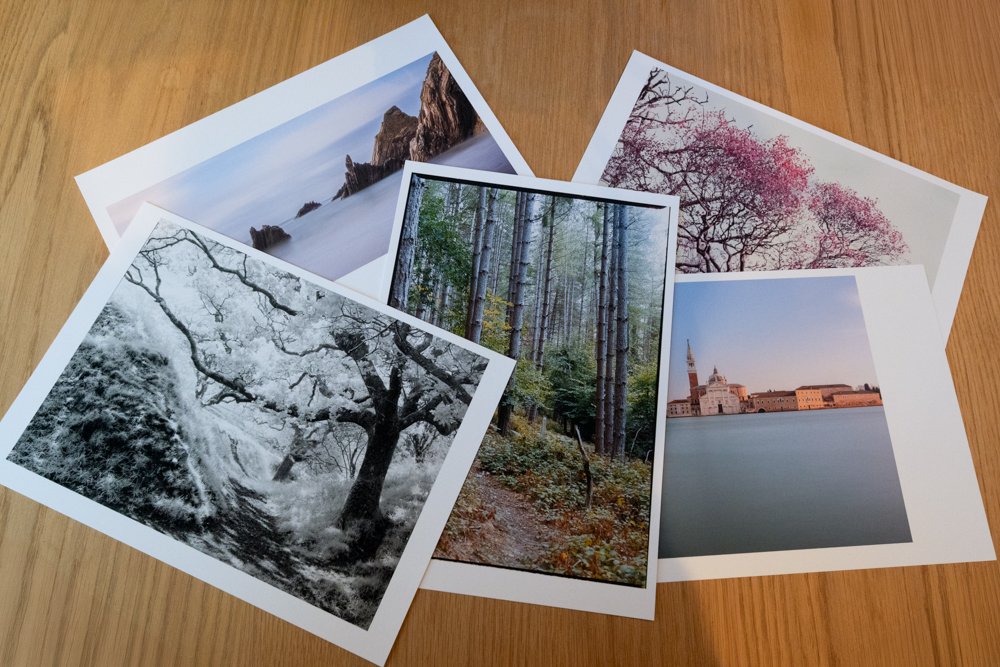
Returning to Photo Printing – My Experience with the Epson EcoTank ET-8550
After years of viewing my photographs on screens, I've rediscovered something I'd almost forgotten: the pleasure of holding a finished photograph in my hands.
Why I Stopped Printing My Photographs
Many years ago, I owned a Canon Pixma Pro 9000, an excellent photographic printer capable of producing some beautiful prints. Unfortunately, it was also rather expensive to run.
The problem wasn't simply the cost of ink used to produce photographs. It was the seemingly endless cleaning cycles, often consuming ink without a single photograph emerging from the printer.
Eventually, during lockdown, I decided to get rid of it.
Since then, I've relied on a fairly ordinary office printer for everyday documents. It does that job perfectly adequately, but photographic printing is another matter entirely. The results are poor, and certainly not something I'd want to display on a wall.
For photographs that deserved something better, I could always use a professional printing service. But that meant another step between taking the photograph and seeing the finished result.
Over time, I realised I missed being able to make my own prints.
Why I Chose the Epson EcoTank ET-8550
My requirements were actually quite straightforward, although finding a printer that satisfied them wasn't necessarily going to be easy.
I have limited space in my office and didn't particularly want two printers. I needed something capable of handling ordinary day-to-day documents while also producing photographic prints of a quality I'd be happy to frame.
I also wanted to print at A3+, giving me considerably more freedom than a conventional A4 printer.
I briefly considered one of Epson's smaller EcoTank printers, but ultimately decided that if I was going to return to photographic printing, I wanted something with greater flexibility.
That led me to the Epson EcoTank ET-8550, an A3+ six-colour printer that uses refillable ink tanks rather than conventional cartridges.
The EcoTank system was particularly appealing after my experience with the Canon. Ink costs had been one of the main reasons I'd abandoned home printing in the first place.
Of course, the ET-8550 isn't a cheap printer to purchase, and the running costs are not zero. But the prospect of producing photographs without constantly worrying about replacing expensive cartridges was attractive.
Another advantage is its versatility. It has conventional paper trays for everyday printing and a rear feed for larger or specialist photographic papers.
For somebody with a relatively small office, that makes a great deal of sense.

Getting Back into the Printing Process
Most of my photographic workflow takes place in Adobe Lightroom Classic.
Whether I'm working with photographs from my Fujifilm GFX100S II or digitised medium-format negatives from my Mamiya 645, Lightroom is where I make the final adjustments.
Printing introduces another stage.
Suddenly, I'm thinking not just about how an image looks on a calibrated monitor, but how it will translate onto a particular paper, using a particular printer and ink combination.
I've been experimenting with Fotospeed paper, including its Matt Ultra 240, and using the appropriate ICC profiles to help manage colour.
The ICC profile is important because it describes how the printer, ink and paper combination reproduces colour. Without the correct profile, what looks right on the monitor can be quite different on paper.
I'm also using Lightroom's soft-proofing facility to get an indication of how the photograph might reproduce before committing it to paper.
It's not an exact science, at least not in my experience so far, but it's an interesting part of the process.
Black and White Has Been a Pleasant Surprise
One of the most encouraging aspects of my early experiments has been black-and-white printing.
The results have been excellent.
I've been particularly pleased with the tonal range and the way the photographs reproduce on paper. There's something about a physical black-and-white photograph that feels quite different from viewing the same image on a backlit monitor.
Subtle transitions, textures and shadow detail take on a different character.
Colour printing has been slightly more complicated.
I've achieved results I'm happy with, but comparing a print with the image on my monitor isn't always straightforward.
The appearance of a colour print depends enormously on the light in which it's viewed. A photograph can look quite different in daylight compared with artificial lighting, and that can make judging the accuracy of the colours rather difficult.
Of course, a monitor produces its own light, while a print relies on reflected light. They're fundamentally different ways of presenting an image.
I'm gradually learning to judge the print on its own merits rather than expecting it to look identical to the screen under every lighting condition.
Printing My Digital and Film Photographs
One of the things I'm particularly looking forward to is printing more of my film photographs.
Over the past year, I've been experimenting with different film stocks, including Kodak Portra, Rollei Infrared and LomoChrome Purple.
I scan my medium-format negatives at home using my Fujifilm GFX100S II, a macro lens and a Valoi film holder.
This gives me high-resolution digital files from the original negatives, which I can then process in Lightroom.
Previously, that was effectively the end of the process. I'd upload photographs to my website, perhaps share a few online, and then move on to the next roll of film.
Now I have the opportunity to take those photographs a stage further.
There's something rather satisfying about starting with a roll of film, exposing it in a camera that's several decades old, digitising the negatives myself and finally producing a physical print.
It's an interesting combination of analogue and digital techniques, and I don't see any contradiction in that.
The photograph is what matters.
The same applies to my digital work. The files produced by the GFX100S II contain extraordinary amounts of detail, but that detail arguably becomes more meaningful when it can be appreciated in a decent-sized print rather than reduced to fit a computer screen.
A Photograph Should Exist Beyond a Screen
I don't believe every photograph needs to be printed.
Most of the images I take will probably continue to live on hard drives, in Lightroom catalogues and on my website.
But there are photographs that deserve something more permanent.
I've recently been renovating parts of our house, and one of my intentions is to display more of my own photography on the walls.
I also like the idea of producing prints for friends and family, and perhaps occasionally for local craft events.
For particularly large or premium prints, I'll still use a professional printing service. I don't expect the ET-8550 to replace every other printing option.
What it does give me is the freedom to experiment.
I can produce a print, live with it for a few days, decide whether it works and perhaps make another version.
That freedom is something I've missed.
The Pleasure of Coming Home
Photography often involves a journey, even if that journey is only a short walk from my front door.
Sometimes it's a woodland in Devon. Sometimes it's Dartmoor, the coast, or somewhere further afield, such as Venice.
I enjoy the experience of being out with a camera, finding compositions and responding to whatever the landscape offers.
But there's also something rather lovely about coming home afterwards.
A photographic trip can be wonderful, but however much I enjoy travelling, there's always a pleasure in returning home.
And I think printing is beginning to feel like an extension of that.
The journey doesn't necessarily end when I put the camera away or import the files into Lightroom.
It ends when I have something tangible in my hands.
A photograph I can hold, place on a table, look at in different light, or eventually hang on a wall.
Perhaps that's what I've missed most during the years when I wasn't printing.
Not the technical process, or even the printer itself, but the feeling that a photograph has finally become something real.
Early Thoughts on the Epson EcoTank ET-8550
It's still early days, and I wouldn't describe this as a comprehensive review.
There are plenty of technical reviews covering print speeds, ink consumption, specifications and colour accuracy.
What interests me more is whether the printer fits into the way I work.
So far, the answer is encouraging.
The black-and-white results have been excellent, the colour prints are promising, and having one printer that can handle both office documents and serious photographic work is a considerable advantage.
I'll undoubtedly learn more as I experiment with different papers, photographs and printing settings.
But perhaps the most important thing is that I'm printing again.
And I'm enjoying it.
For me, that's a rather good reason to have bought the Epson EcoTank ET-8550.
0 Comments