
Returning to a Woodland Walk After Ten Years
A couple of days ago, the weather finally offered a brief break from what felt like an endless run of rain. The forecast wasn't perfect, but it was good enough to tempt us outdoors. Better still, it provided an excuse to stop for a proper breakfast at Aune Valley Farm Shop before heading out for a walk.
The plan wasn't really a photography trip. My wife, my mother-in-law and I were scouting a route that might be suitable for our Lakeland Terrier. The walk is a circular route of around three to four miles that takes in the area around Avon Mill, sections of the old Primrose railway line and a network of ancient green lanes.
I had walked it once before, probably ten years ago. Like many places, it had stayed in the back of my mind as somewhere I meant to revisit but somehow never quite got around to. Life has a habit of doing that. Years pass surprisingly quickly and walks become memories.
This time, I decided to take a camera.
I'm very glad I did.
What Is a Green Lane?
For anyone unfamiliar with the term, a green lane is usually an ancient route that predates modern roads. Often enclosed by hedges, banks or woodland, these routes were once used by people, livestock and carts travelling between villages and farms.
Walking them feels very different from walking a modern footpath. There is often a sense of history beneath your feet. The routes seem to follow the landscape rather than cut through it, twisting and turning through woodland, around hillsides and across streams.
The lanes around Loddiswell have exactly that feeling.
A Landscape That Feels Like a Rainforest
One of the reasons I enjoy this area so much is that it feels completely different from nearby Dartmoor.
I love Dartmoor. The open spaces, the tors and the constantly changing weather are part of what makes it special. Yet only a short drive away, this walk offers almost the exact opposite experience.
Instead of open moorland, you find yourself surrounded by dense woodland. Ferns crowd the paths. Moss covers stone banks and tree roots. Sunlight filters through layers of leaves overhead. In places the vegetation becomes so lush that it feels closer to a temperate rainforest than the landscape many people imagine when they think of Devon.
As we walked, we found ourselves stopping regularly.
Not because the route was difficult, but because there was simply so much to take in.
Taking the Fujifilm GFX100S II
Although photography wasn't the primary purpose of the day, I decided to take my Fujifilm GFX100S II with the GF 35-70mm lens.
The reasoning was simple.
If I was going to carry a camera, I wanted the best image quality available to me. The GF 35-70mm isn't a large lens, which meant the overall setup remained surprisingly manageable for a walk of this length.
All of the photographs in this article were taken hand-held using Aperture Priority mode and the camera's excellent in-body image stabilisation. I also used a circular polarising filter throughout the walk to deepen foliage colours and reduce reflections from wet leaves.
The weather was a mixture of broken cloud and sunshine. In typical fashion, the sun seemed determined to appear every time I found a composition. While the light was beautiful, it occasionally created bright hotspots on leaves where direct sunlight broke through the canopy. Even with some negative exposure compensation dialled in, those highlights occasionally pushed close to clipping.
Such is woodland photography.
I also chose to work using the camera's 1:1 crop mode. Over the past few years I've become increasingly fond of the square format. Woodland scenes can quickly become cluttered, with branches, leaves and distractions pulling the eye in multiple directions. The square frame encourages a simpler approach. It feels more deliberate and, for me at least, suits intimate woodland photography particularly well.
Most of the images remained exactly as they were composed in camera. The only exception was the final swamp photograph, where I decided to allow a little more space on the left-hand side of the frame during processing.
Photograph One: Ferns and a Solitary Flower
The first photograph I made was also one of the simplest.
A cluster of ferns had formed an almost circular pattern around a small opening in the centre. Nestled amongst the greenery was a solitary pink flower.
What attracted me wasn't any grand landscape but the pattern itself. The repeating shapes of the fern fronds created a natural abstract composition. The flower became a small point of contrast within a sea of green.
One of the joys of woodland photography is that you can move from photographing an entire landscape to photographing something only a few inches across.
Sometimes the smaller photographs become the most memorable.
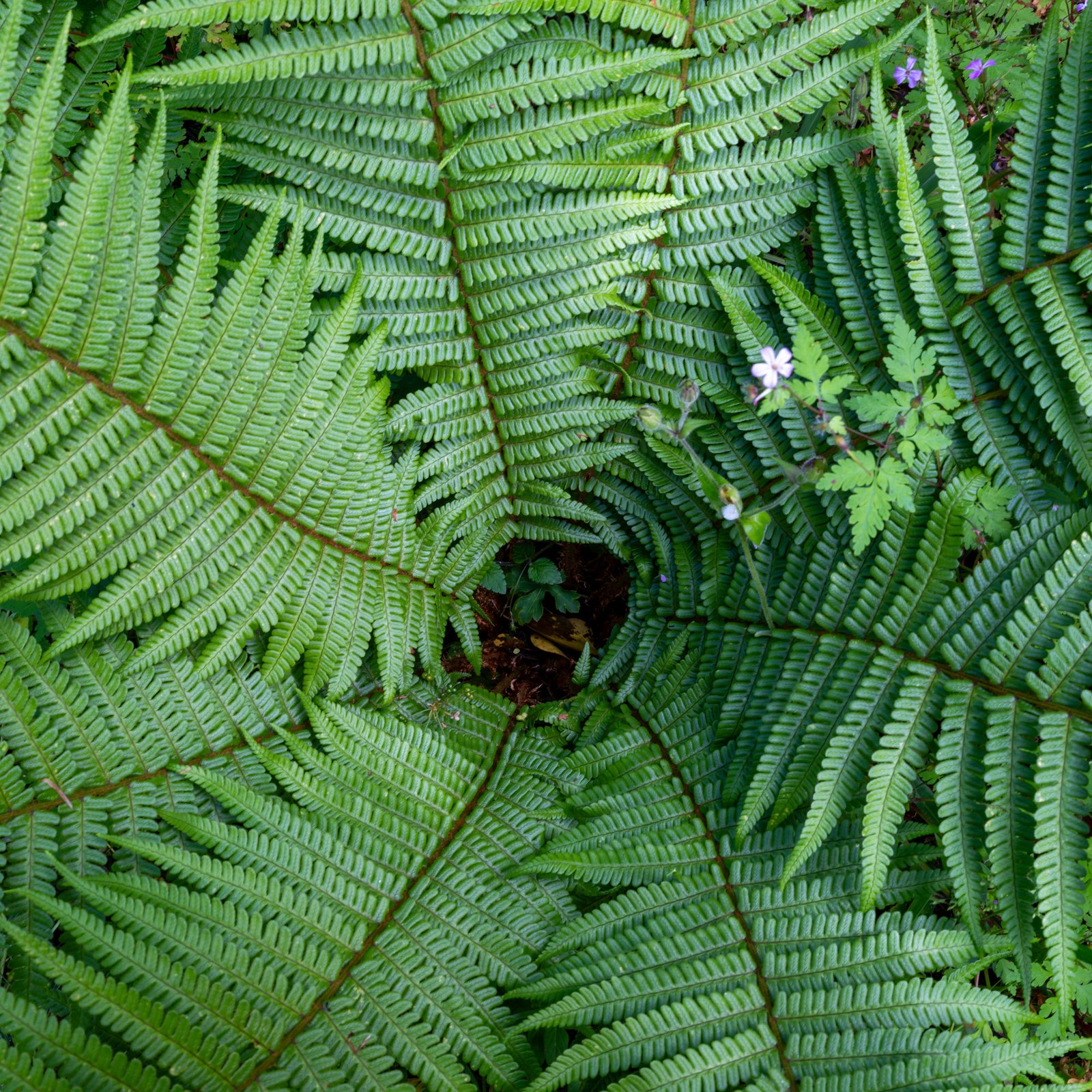
Ferns and a Solitary Flower – Layers of fern fronds surround a single pink flower hidden within the woodland undergrowth.
Photograph Two: Moss, Stone and Light
Further along the route I came across a steep bank covered in moss.
The scene immediately caught my attention because of the way the sunlight was striking the vegetation. There was no dramatic shaft of light, just a gentle illumination that revealed the texture of the rocks and moss.
Woodland photography often rewards patience and observation more than dramatic conditions.
This was not a scene that would stop passing tourists in their tracks.
Yet standing there, surrounded by trees and looking at the subtle play of light across the moss-covered bank, it felt like exactly the sort of photograph I wanted to make.
Walking the Primrose Line
Part of the route follows sections of the former Kingsbridge branch railway, often referred to locally as the Primrose Line.
Opened in 1893, the railway connected Kingsbridge to the wider rail network before eventually closing in 1963. Today, many sections survive as footpaths, allowing walkers to enjoy a route that once carried passengers and goods through the South Hams countryside.
Walking former railway lines always gives me a sense of travelling through layers of history.
The trains are long gone.
The stations have largely disappeared or found new purposes.
Nature, meanwhile, continues reclaiming the landscape.
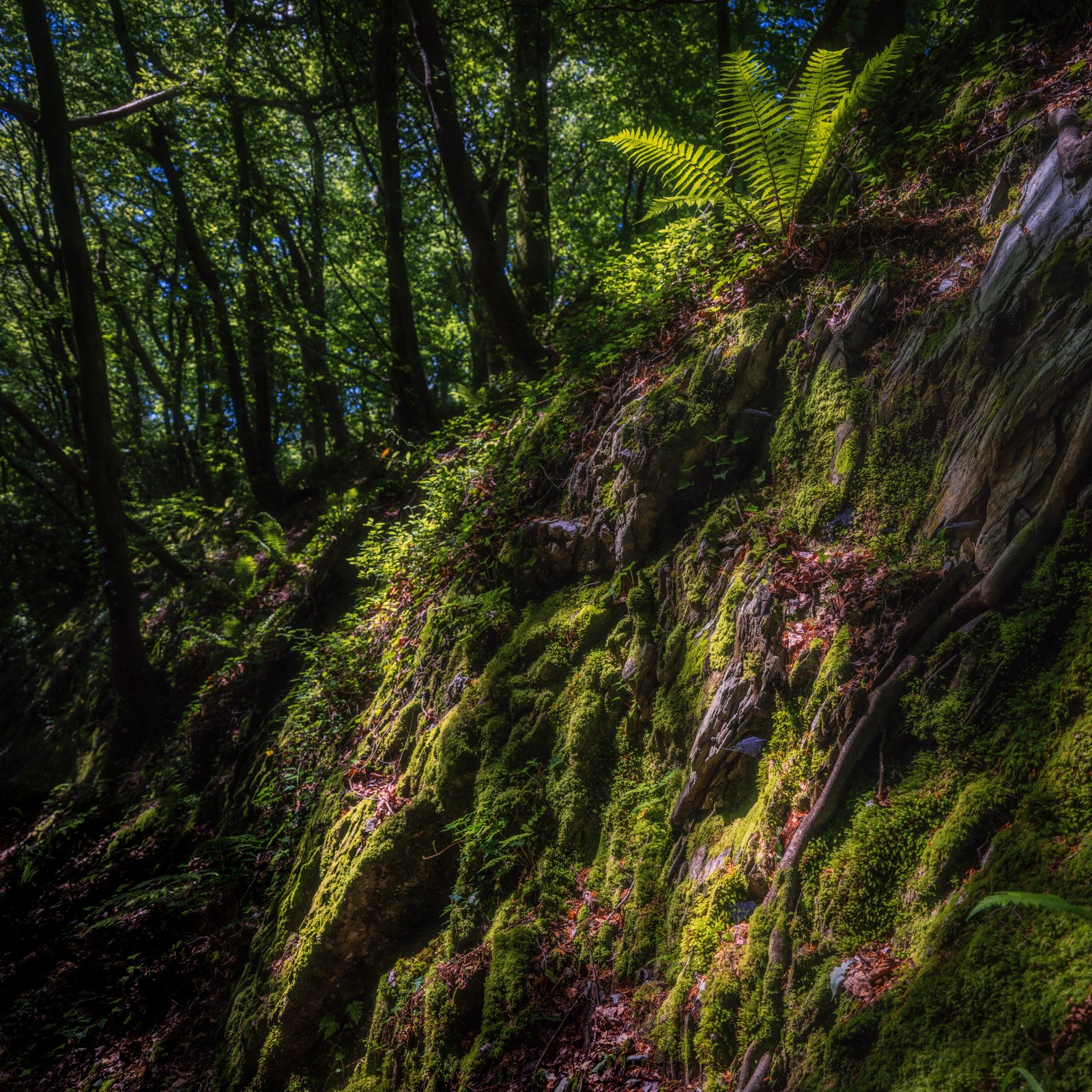
Woodland Light – Moss-covered rocks catching the afternoon light beneath the trees.
Photograph Three: A South Devon Rainforest
If there was a theme running through this walk, it was ferns.
They seemed to be everywhere.
The third image attempts to capture something of that abundance. Layers of vegetation overlap one another, creating a scene that feels almost chaotic at first glance.
Yet the chaos is part of what attracted me.
Woodland photography doesn't always have to be about imposing order on nature. Sometimes the challenge is allowing a degree of complexity to remain while still creating a coherent photograph.
The image reminds me why I enjoy these environments so much. They are messy, unpredictable and endlessly fascinating.
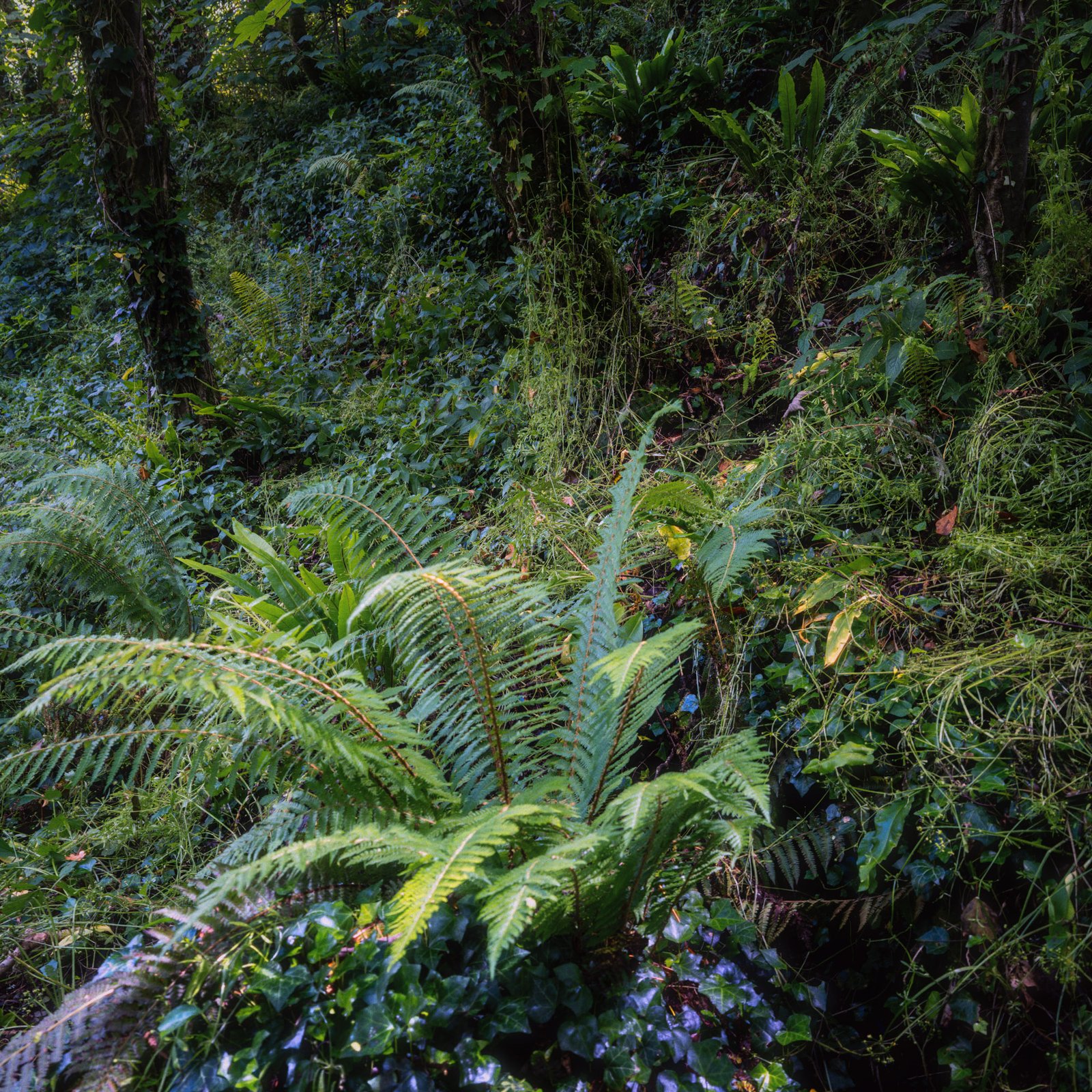
A South Devon Rainforest – Dense vegetation along one of the green lanes between Loddiswell and Avon Mill.
The Unexpected Swamp
The final photograph was perhaps the biggest surprise of the day.
Hidden amongst the woodland, away from the main path, we stumbled across what I can only really describe as a swamp-like area.
I wasn't expecting it at all.
What initially caught my eye were the reflections. Leaves, branches and patches of sky were mirrored across the still water. Old stumps emerged from the surface, creating strange shapes that seemed to belong to another world.
Getting the photograph required a small scramble down a bank.
Looking back, I suspect that image is the one that will stay with me the longest.
Not because it is necessarily my favourite photograph, but because it was completely unexpected.
Those discoveries are often what make a walk memorable.
You set out with one idea of what you'll find and return home with something entirely different.
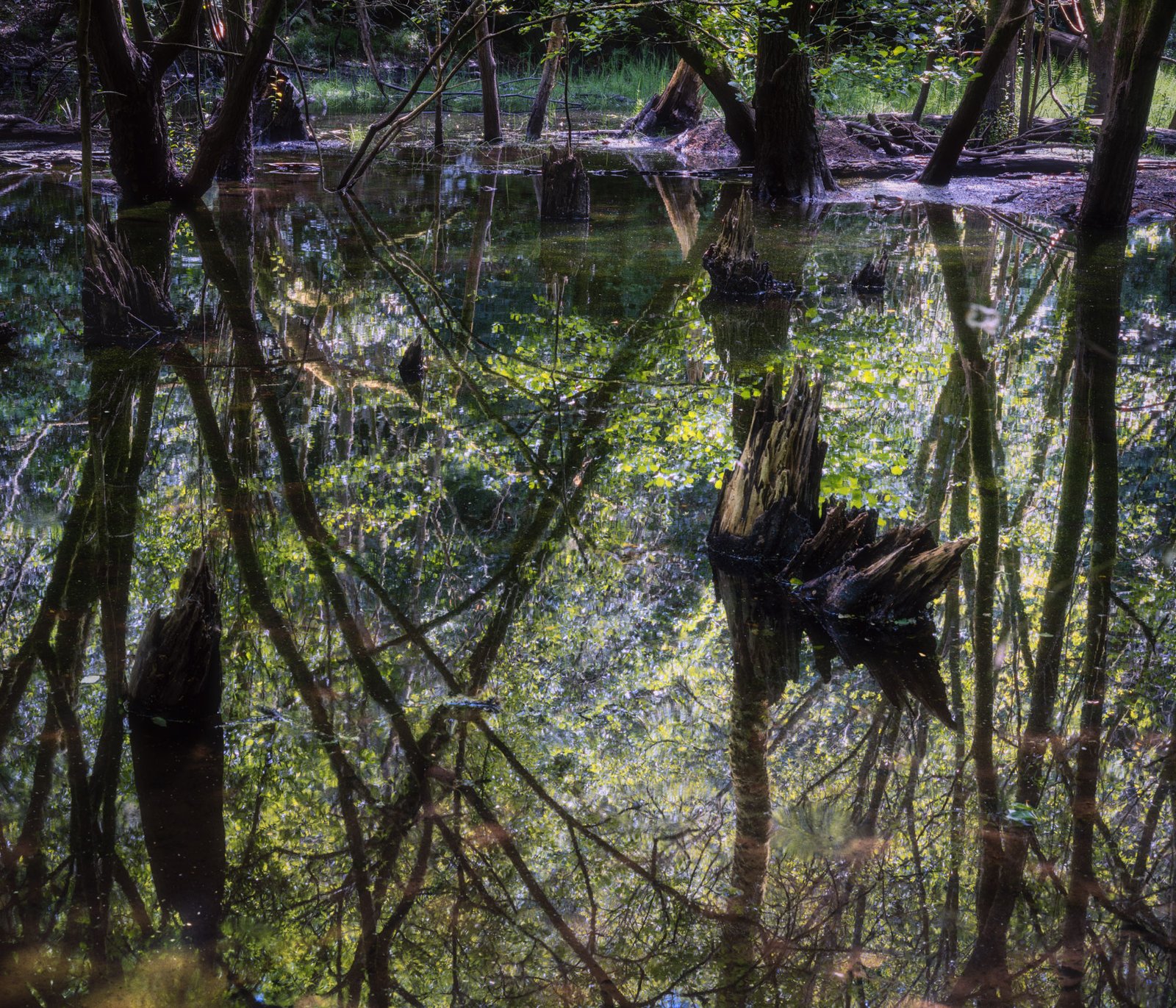
Unexpected Reflections – A hidden swamp-like pool where reflections, stumps and still water created an abstract woodland scene.
Processing the Images
Back home, the editing process was relatively straightforward.
Most adjustments involved selective dodging and burning within Lightroom to guide the viewer's eye through the frame.
I then used Dehancer Pro together with a Fujifilm Provia-inspired look. The goal wasn't to create a heavily stylised image but simply to moderate some of the stronger greens. Straight out of camera they felt slightly too intense for the atmosphere I remembered.
The resulting photographs feel closer to the experience of being there.
Why Walks Like This Matter
As photographers, it's easy to fall into the trap of always chasing the next location.
The next dramatic coastline.
The next mountain.
The next spectacular sunrise.
Yet this walk reminded me that some of the most rewarding experiences can be found much closer to home.
A route I had not walked in ten years turned out to contain dense woodland, ancient green lanes, a disused railway, countless ferns and an unexpected swamp filled with reflections.
Not bad for a simple afternoon walk.
The photographs are important, of course. I wouldn't have carried the camera otherwise.
But what I will remember most is the experience itself: walking slowly through woodland, stopping regularly to look around, and rediscovering a corner of South Devon that I had almost forgotten.
Sometimes photography is less about finding new places and more about returning to old ones with fresh eyes.
Want to see the behind the scenes of this walk why not watch the video below.
0 Comments