
Autumn Woodland Photography on Dartmoor – Dewerstone and Soussons Wood
Sometimes the best photographs are the ones you never intended to take.
Woodland photography rarely goes entirely to plan. You can spend hours looking at weather forecasts, hoping for mist drifting between the trees or waiting for the right light, only to arrive and discover that nature has something entirely different in mind.
During two autumn visits to Dewerstone and Soussons Wood on Dartmoor, I found myself in both situations.
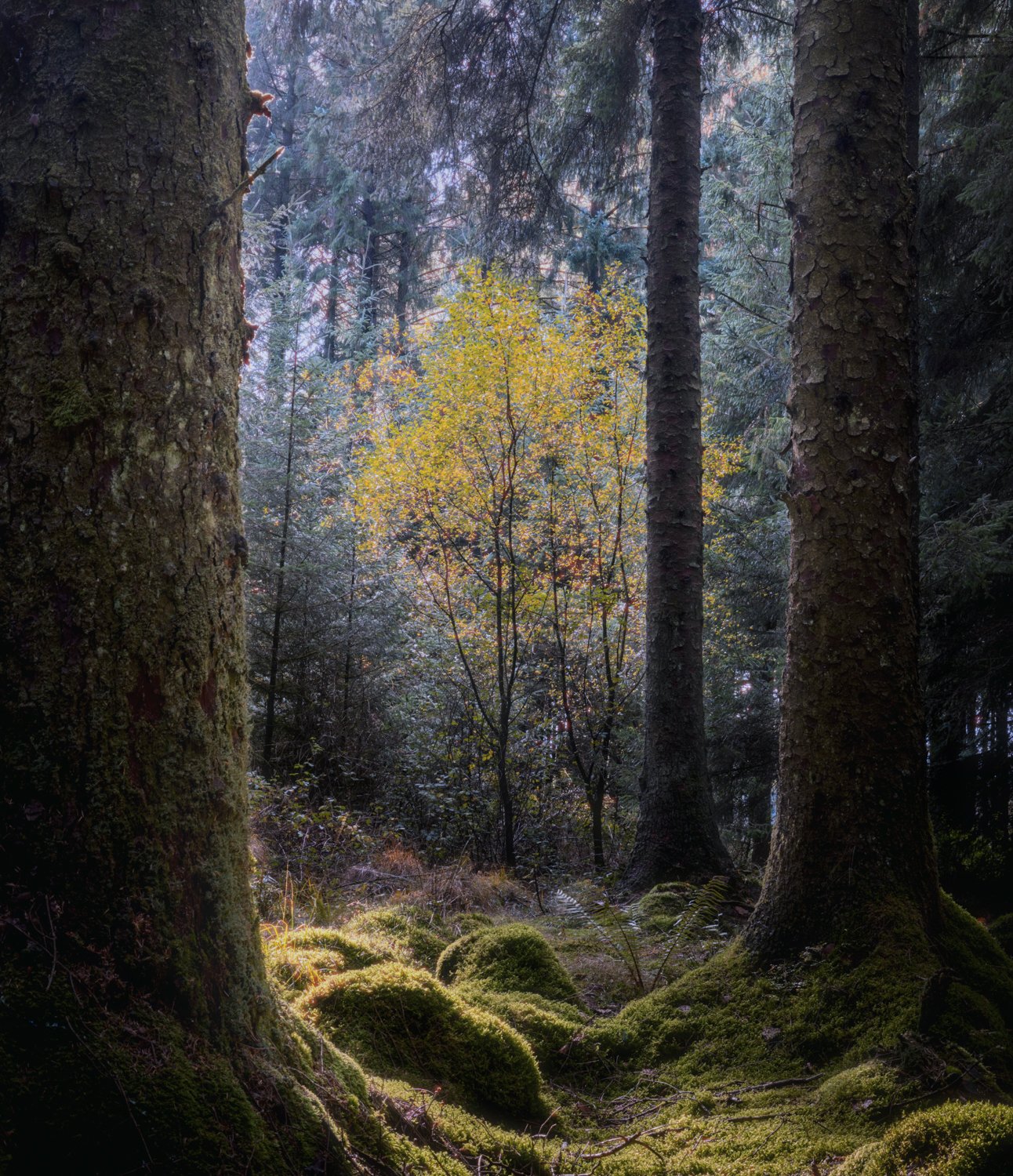
At Soussons, I was waiting for mist that never arrived, but turning around revealed a small yellow tree illuminated against the dark conifers. At Dewerstone, I'd already decided the best light had passed when the low sun began filtering through the woodland as I walked back towards the car.
Neither was quite the photograph I'd set out to make, but both became some of my favourite images from these outings.
The two woodlands are quite different in character. Soussons is dominated by tall, closely planted conifers, while Dewerstone offers a more natural, tangled landscape of twisted trees, moss-covered boulders and autumn bracken.
What connects them, at least for me, is the challenge of finding compositions among the trees and making the most of whatever light happens to be available.
Soussons Wood – Finding Autumn Colour Among the Conifers
Soussons Wood is a conifer plantation on Dartmoor, and much of it consists of tall, closely planted trees.
The trunks create repeating vertical patterns, while the dense canopy restricts the amount of light reaching the forest floor. Even during the middle of the day, parts of the woodland can feel surprisingly dark.
I'd visited hoping for mist.
Mist can be particularly effective in woodland photography because it helps separate the trees, softens distracting backgrounds and creates a sense of depth. In a plantation such as Soussons, where the trunks stand so closely together, even a little mist could transform the scene.
Unfortunately, it wasn't to be.
There was no mist drifting between the trees, and the woodland looked quite different from the scene I'd imagined before leaving home.
Nevertheless, I continued exploring, looking at the repeating patterns of the trunks and the patches of moss covering the uneven forest floor.
A Small Tree in the Light
While waiting for conditions to improve, I turned around and noticed something I hadn't been looking for.
A small deciduous tree, still holding its yellow autumn leaves, was illuminated by light filtering through the surrounding conifers.
Against the darker woodland, the leaves seemed to glow.
What appealed to me was the contrast between the delicate little tree and the enormous trunks surrounding it.
The conifers created a natural frame, almost like looking through a tunnel into a small clearing. The yellow leaves provided a splash of colour against the darker greens and browns of the plantation.
The backlighting was particularly effective, giving the leaves a luminosity that would have been difficult to achieve under the flat, overcast conditions I'd originally hoped for.
I liked the simplicity of the scene. Although there was plenty happening in the surrounding woodland, the illuminated tree provided a clear subject.
It was a completely different photograph from the misty woodland scene I'd imagined.
And perhaps a more interesting one because of it.
Finding Order Among the Pines
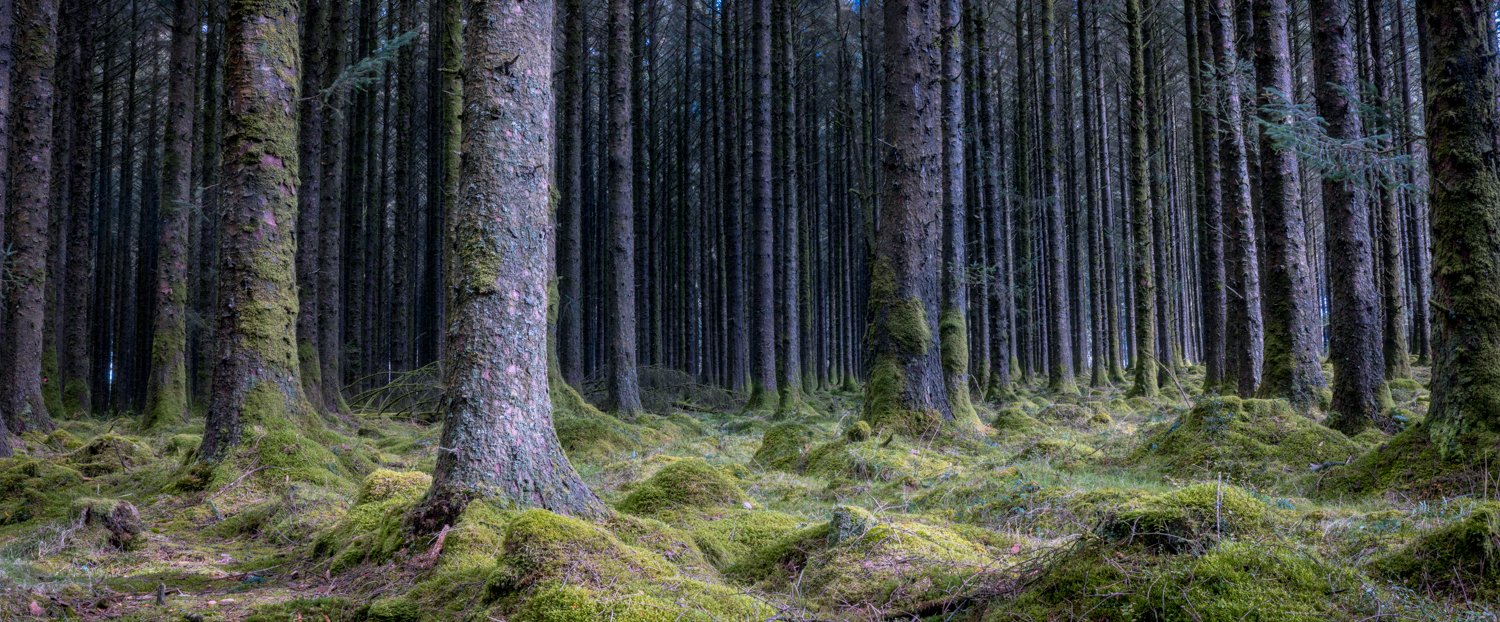
Elsewhere in Soussons, I found myself drawn to the repeating patterns of the conifer trunks.
Unlike the ancient woodland at Dewerstone, where trees grow in seemingly every direction, the plantation has a much more ordered appearance.
The closely spaced trunks form a series of vertical lines, gradually disappearing into the darker woodland beyond.
For this photograph, I chose a panoramic composition.
The wider format allowed me to explore the repetition of the trees while keeping the emphasis on the moss-covered forest floor and the subtle variations in light.
What interested me was the contrast between the dark spaces deeper in the plantation and the much lighter greens of the moss.
The foreground trees provide a sense of scale, while the smaller trunks in the distance create depth.
There's very little dramatic light in this photograph, but I rather like its quietness.
Not every woodland photograph needs shafts of sunlight or drifting mist. Sometimes the arrangement of the trees, the textures of the forest floor and the subtle changes in colour are enough.
In some respects, the photograph is almost the opposite of the backlit yellow tree.
One relies on a small area of colour and light to attract attention, while the other is about repetition, structure and the atmosphere of the woodland itself.
Both were made in the same forest, yet they tell rather different stories.
Dewerstone – Twisted Trees and Moss-Covered Boulders
Dewerstone offers a very different photographic experience.
The woodland is less orderly, with twisting branches, moss-covered boulders, fallen timber and bracken covering the uneven ground.
It's the sort of place where there seems to be a potential photograph in almost every direction, although finding a composition that actually works can be surprisingly difficult.
There is so much happening visually that it's easy for the photograph to become cluttered.
Branches overlap, tree trunks merge into one another, and the woodland floor is filled with rocks, vegetation and fallen leaves.
I spent time exploring, looking at the relationships between the trees, rocks and surrounding vegetation.
Rather than searching for a grand view, I was interested in the smaller scenes and the character of the woodland itself.
The Twisted Oak
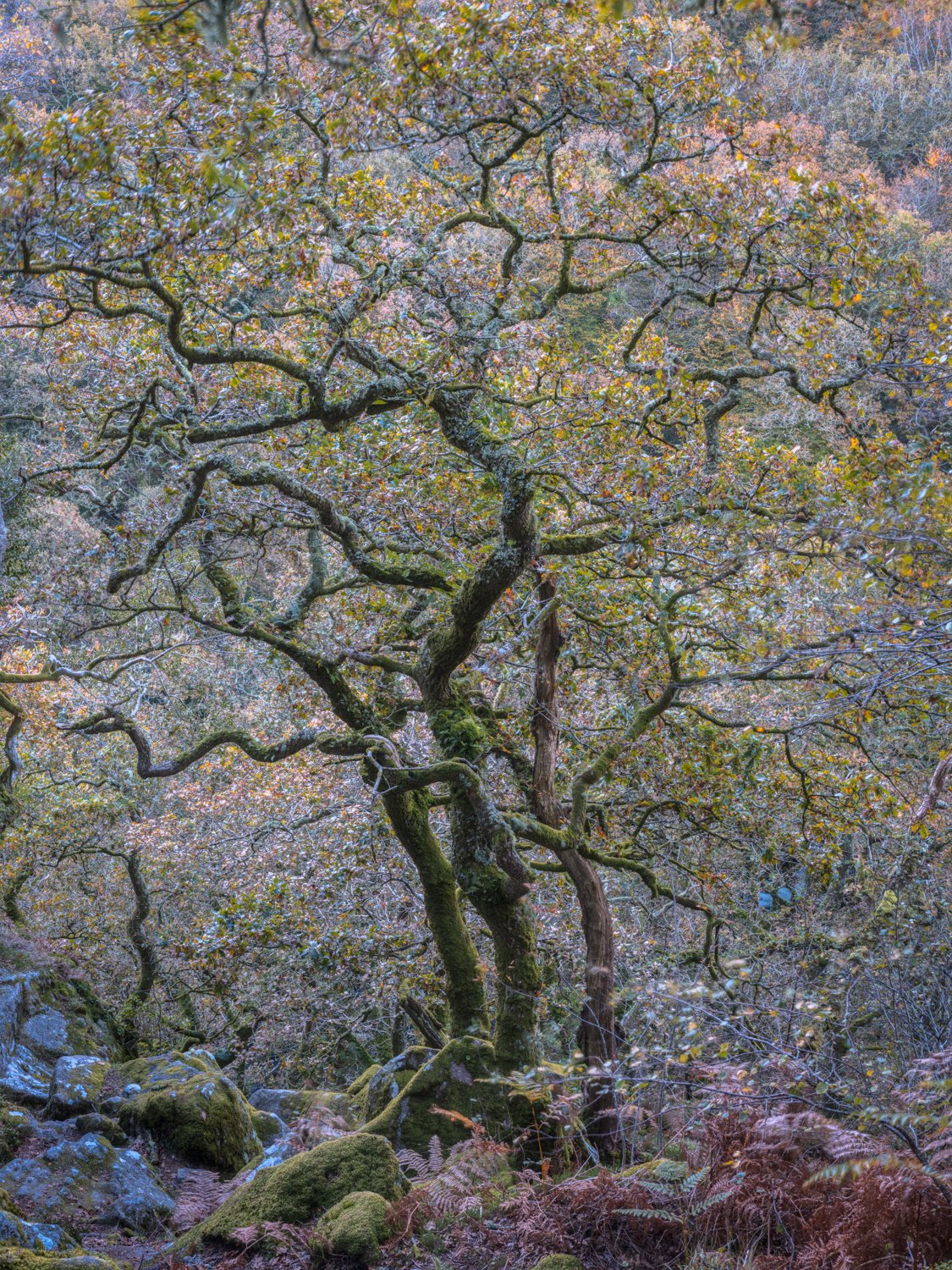
One of the trees that caught my attention had a wonderfully complicated structure.
Its branches stretched out in different directions, twisting and turning through the surrounding woodland.
What interested me wasn't simply the tree itself, but the way its branches seemed to fill the frame, creating an intricate pattern of lines and shapes.
The remaining autumn leaves added small patches of colour among the moss-covered branches.
It's quite a busy photograph, and I suspect it won't appeal to everyone.
However, I enjoy these more complicated woodland scenes. They encourage you to spend a little longer looking, gradually discovering the shapes and details hidden within the composition.
There is something almost painterly about the arrangement of the branches and the muted autumn colours.
The challenge was finding a composition that allowed the tree to retain its character without becoming completely lost in the surrounding woodland.
Rather than trying to simplify everything, I decided to embrace some of that complexity.
After all, the tangled nature of the woodland is part of what makes Dewerstone interesting.
Moss, Granite and the Woodland Floor
The Best Light Came on the Way Back
By this point, I was beginning to think that the best light had passed.
I'd spent time exploring the woodland and was making my way back towards the car.
Then the light changed.
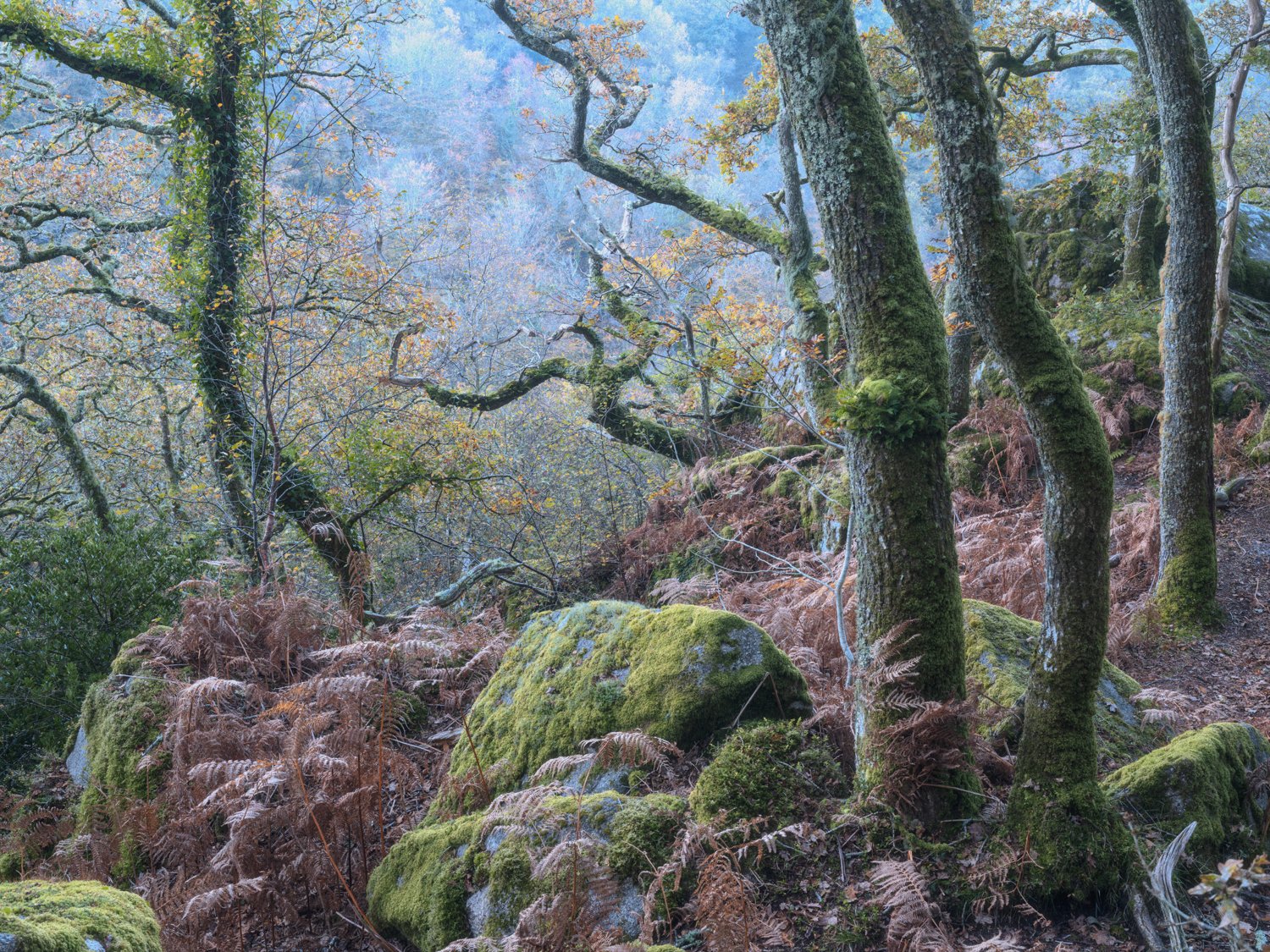
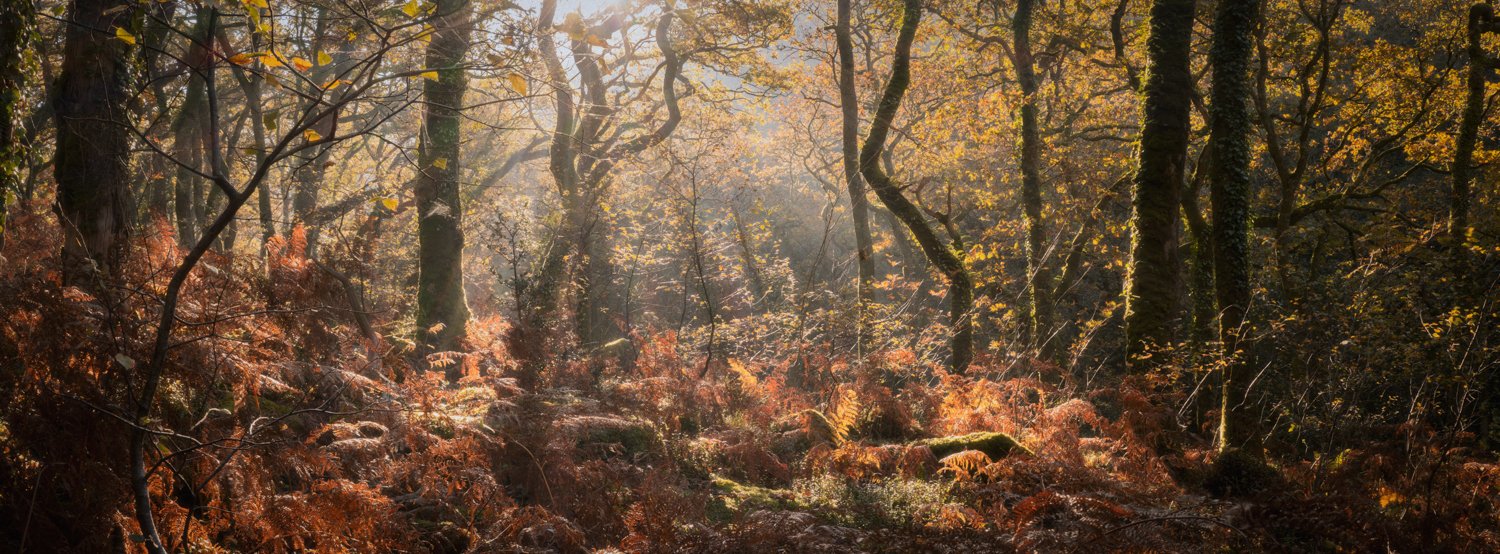
As I walked through the trees, sunlight began filtering through the canopy, illuminating patches of autumn bracken and moss-covered rocks.
The woodland suddenly took on a completely different appearance.
Areas that had previously looked rather flat were now filled with warm light, while the surrounding trees remained in shadow.
The backlighting caught the edges of the bracken, giving the leaves a delicate glow.
It was one of those moments when an otherwise complicated woodland scene suddenly begins to make sense.
The light provided the separation that had been missing earlier, picking out individual trees and patches of vegetation against the darker background.
I stopped and began looking for a composition.
Rather than concentrating on an individual tree, I wanted to capture the way the light spread across the woodland floor.
I chose a panoramic format, allowing the photograph to follow the illuminated bracken through the trees.
The warm autumn colours contrasted with the darker trunks, while the light filtering through the woodland created a sense of depth.
I particularly liked the way the illuminated patches of bracken were scattered across the scene, creating a natural rhythm through the photograph.
It was precisely the sort of light I'd hoped to encounter earlier in the visit.
The irony was that I'd already decided the photography was probably finished.
Had I been concentrating solely on getting back to the car, I could easily have walked straight past it.
Working With the Light Rather Than the Forecast
Looking back at these two outings, what interests me most is how little the resulting photographs depended on the conditions I'd originally hoped for.
At Soussons, the mist never arrived, but turning around revealed a small yellow tree illuminated against the dark conifers.
At Dewerstone, some of the most interesting light appeared after I'd convinced myself the best conditions were over.
There's nothing particularly unusual about any of this. Anyone who spends time photographing landscapes will have experienced similar situations.
Nevertheless, it's remarkably easy to become fixated on a particular photograph or set of conditions.
We imagine the mist drifting between the trees, the sun breaking through the clouds at precisely the right moment, or the landscape illuminated by beautiful soft light.
When those things don't happen, it's tempting to regard the outing as unsuccessful.
Yet there are often photographs waiting to be discovered elsewhere, sometimes only a few metres away or simply by turning around.
One of the things I enjoy about woodland photography is that the light doesn't necessarily behave in the same way as it does in an open landscape.
A small opening in the canopy can illuminate a single tree, while the surrounding woodland remains almost completely dark.
A change in the sun's position can transform the forest floor, picking out details that were barely visible a few minutes earlier.
And sometimes, the most interesting light isn't in front of you at all.
Camera and Equipment
All five photographs featured in this article were taken with my Fujifilm GFX100S II and the Fujinon GF 35–70mm lens.
The combination works particularly well for the sort of woodland photography I enjoy.
Although the GFX100S II is a medium-format camera, the relatively compact GF 35–70mm makes it a manageable system to carry while exploring woodland.
The zoom range also provides plenty of flexibility when working with complicated compositions.
In woodland, moving a few steps to the left or right can completely change the relationship between the trees. Being able to make small adjustments to the framing without changing lenses is particularly useful.
For the two panoramic photographs, I wanted the compositions to emphasise the way the woodland extended across the frame rather than concentrating on a single subject.
The high-resolution sensor provides plenty of flexibility when choosing different aspect ratios, allowing me to explore wider compositions without sacrificing too much detail.
However, the camera and lens were really secondary to the light and the compositions I encountered.
A Reason to Keep Looking
One of the things I enjoy most about photographing Dartmoor is that even familiar locations can offer something different each time you visit.
The weather changes, the seasons move on, and the light can transform a scene in a matter of minutes.
Dewerstone and Soussons are very different woodlands, yet both offered photographs I hadn't anticipated making.
At Soussons, a small yellow tree became the subject when the mist failed to arrive.
At Dewerstone, the warm autumn light appeared just as I was preparing to leave.
These visits reminded me that it's worth remaining open to whatever the landscape offers rather than becoming too attached to the photograph I'd imagined before leaving home.
There will always be occasions when the mist doesn't arrive or the light doesn't behave as expected.
But sometimes, when you think the best light has gone and you're walking back towards the car, the landscape has one more photograph waiting for you.
You just have to notice it.
0 Comments