
Photographing Wistman's Wood in Autumn – Light, Colour and Composition
Wistman's Wood is one of those places on Dartmoor that I find myself returning to. I've photographed it several times over the years, yet I still feel there's something I've been missing. Every visit has been different, but the one thing I've never managed to experience is the woodland in mist.
It's something I'd particularly love to photograph. The ancient, twisted oak trees, their branches covered in moss and lichen, seem made for those damp, atmospheric conditions. Add a little autumn colour and some bright mist filtering through the woodland, and I imagine it would be quite spectacular.
Unfortunately, the weather has never quite cooperated.
On this particular visit, I arrived just before seven in the morning, hoping for mist or perhaps a little drizzle. Instead, I was greeted by rather more sunshine than I'd wanted.
As it turned out, that wasn't necessarily a bad thing.
The woodland was displaying some wonderful autumn colours, and although the bright light initially presented a few problems, it also offered opportunities I hadn't anticipated. By the time I left a couple of hours later, I'd begun to see Wistman's Wood a little differently.
Returning to Wistman's Wood
There's something rather extraordinary about Wistman's Wood. It isn't a particularly large woodland, but what it lacks in size it more than makes up for in character.
The twisted oak trees grow amongst granite boulders, their branches bending and intertwining in seemingly impossible directions. Thick moss covers much of the exposed rock and wood, while lichen hangs from the branches, adding to the sense that this is somewhere quite removed from the surrounding moorland.
It's this combination of twisted trees and moss that keeps drawing me back.
There's an atmosphere to the place that I find difficult to describe. Even in relatively ordinary conditions, the woodland has a slightly otherworldly appearance. The trees seem to have developed their own shapes and personalities, and there's very little of the regularity you might find in a more conventional woodland.
Photographically, however, that character can be quite difficult to capture.
With so many branches, boulders and overlapping shapes, it's easy to end up with an image that contains plenty of interesting details but doesn't quite work as a photograph.
I think that's partly why I keep returning. There's always another composition to discover, another arrangement of branches or a different way of looking at a familiar tree.
On previous visits, I've generally photographed from the lower side of the woodland, looking uphill. Some of my favourite trees are towards the bottom, and photographing from below can give them a wonderful presence.
The difficulty is the sky.
Even when the woodland appears relatively dense, there are numerous gaps between the branches. Looking uphill, those gaps can introduce patches of bright sky into the composition, drawing attention away from the trees themselves.
This time I decided to approach things differently.
A Different Viewpoint – Photographing Downhill
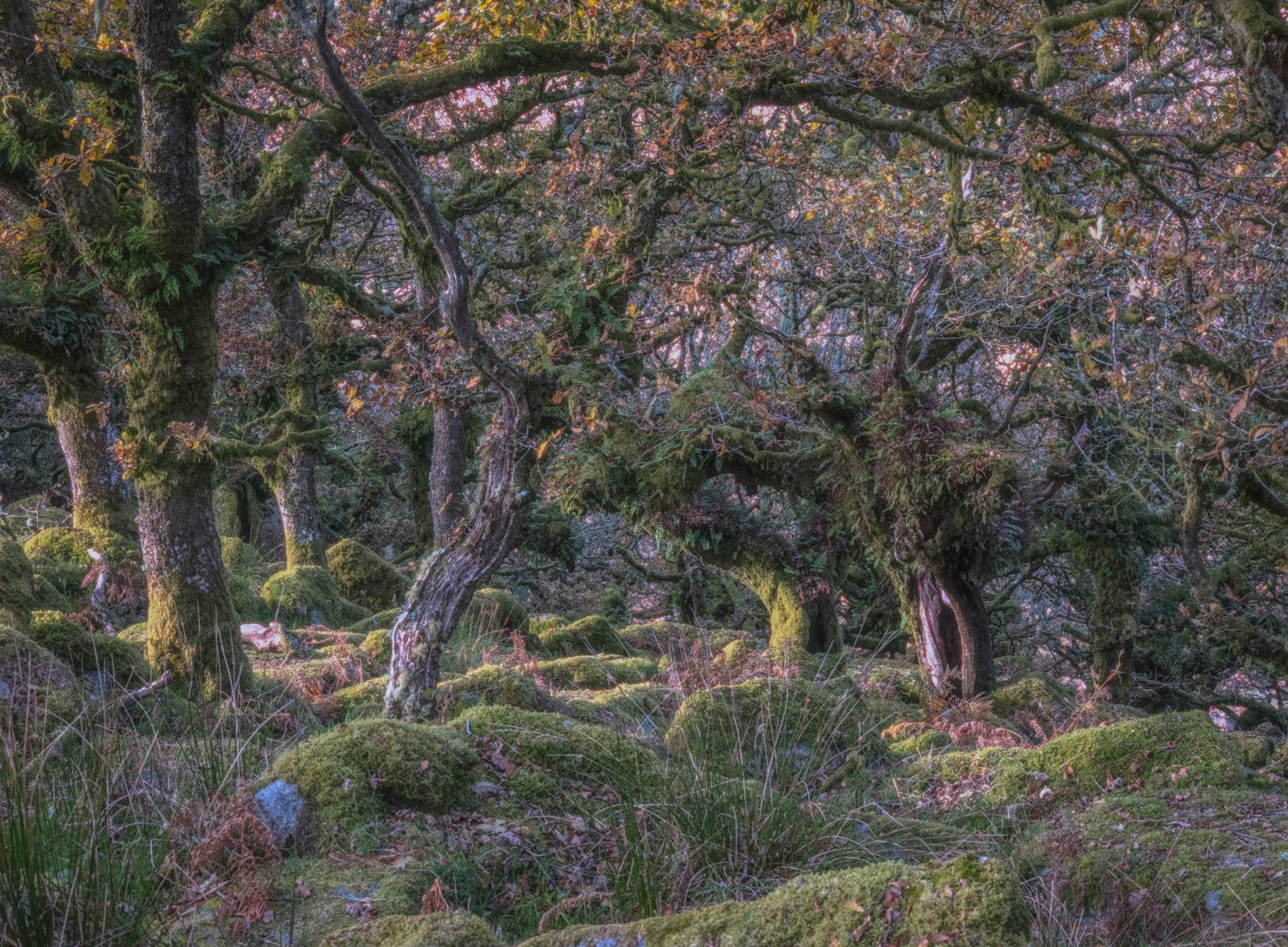
Rather than working from the bottom of Wistman's Wood and photographing uphill, I spent my time along the upper side, looking down through the trees.
It might sound like a relatively small change, but photographically it makes quite a difference.
By looking downhill, I could use more of the woodland itself as the background. Instead of bright sky appearing between the branches, there were moss-covered rocks, darker trees and patches of autumn foliage.
This helped bring the different elements of the scene together.
It also suited the kind of photographs I was looking for on this visit. I wasn't necessarily trying to isolate individual trees or create particularly simple compositions. I was interested in the complexity of the woodland, the way branches and leaves blend into the background, and the occasional splash of colour amongst the greens and browns.
Photographing from above gave me more opportunities to explore those relationships.
There were still difficulties, though.
One thing I found myself wishing for was a taller tripod.
I use a tripod for all my woodland photography, but there were several occasions when I wanted the camera perhaps another foot higher. Some of the bases of the trees were partially obscured by boulders or fallen branches, and a slightly elevated viewpoint would have allowed me to photograph over those obstructions.
It's a relatively minor frustration, but one that becomes quite noticeable when you're spending time carefully arranging a composition.
Sometimes moving the camera just a few inches can completely change how different elements overlap. An extra foot of height would have given me considerably more flexibility.
I was also conscious of the fragility of Wistman's Wood. I deliberately remained outside the woodland, photographing from its edges rather than entering amongst the trees.
The mosses, lichens and vegetation are part of what makes this place so special, and I don't think a photograph is worth damaging them for.
Fortunately, there are plenty of photographic opportunities from outside the woodland itself.
Waiting for the Right Light
The biggest challenge of the morning was undoubtedly the sunshine.
I'd arrived hoping for mist, or at least the kind of soft, damp conditions that tend to work so well in woodland photography.
Instead, the sun was making its presence felt.
Bright sunshine can be particularly troublesome in woodland. It creates patches of intense light amongst deep shadows, and the resulting contrast can make an already complicated scene even more difficult to photograph.
At Wistman's Wood, the moss-covered boulders and twisted branches were catching the sunlight unevenly. Some areas were brightly illuminated while others remained in deep shade.
The resulting hotspots were distracting, particularly when they appeared in the background of a composition.
Rather than abandoning the photographs, I began waiting for the sun to disappear behind passing clouds.
The difference was quite dramatic.
As soon as a cloud softened the sunlight, the harsh highlights disappeared. The light remained bright enough to illuminate the woodland, but it became much more even.
The moss-covered surfaces seemed almost to glow.
What had previously been a rather difficult mixture of bright highlights and dark shadows became a much more harmonious arrangement of colours and textures.
The yellow leaves retained their vibrancy, while the greens of the moss became particularly rich.
I found myself composing photographs while the sun was out, then waiting for the right moment to make the exposure.
In some ways, the less-than-ideal conditions actually improved my approach.
Because I couldn't simply take a photograph whenever I found something interesting, I spent longer considering each composition. I had time to look around the edges of the frame, examine how branches overlapped and decide whether the different colours were working together.
When the sun eventually disappeared behind a cloud, I was ready.
It was occasionally frustrating, particularly when the light changed just as I was about to take a photograph, but the results made the waiting worthwhile.
I still think Wistman's Wood would look wonderful in bright autumn mist, but this experience reminded me that soft light doesn't necessarily require fog or heavy cloud cover.
Sometimes a passing cloud is enough.
Finding Beauty in the Chaos
One of the things I particularly enjoy about woodland photography is the challenge of making sense of complicated scenes.
Much of the advice surrounding woodland composition concentrates on simplifying the image. Find a subject, separate it from the background and remove anything that might distract the viewer.
That's perfectly sensible advice, and it's something I often try to do myself.
But sometimes I'm interested in almost the opposite.
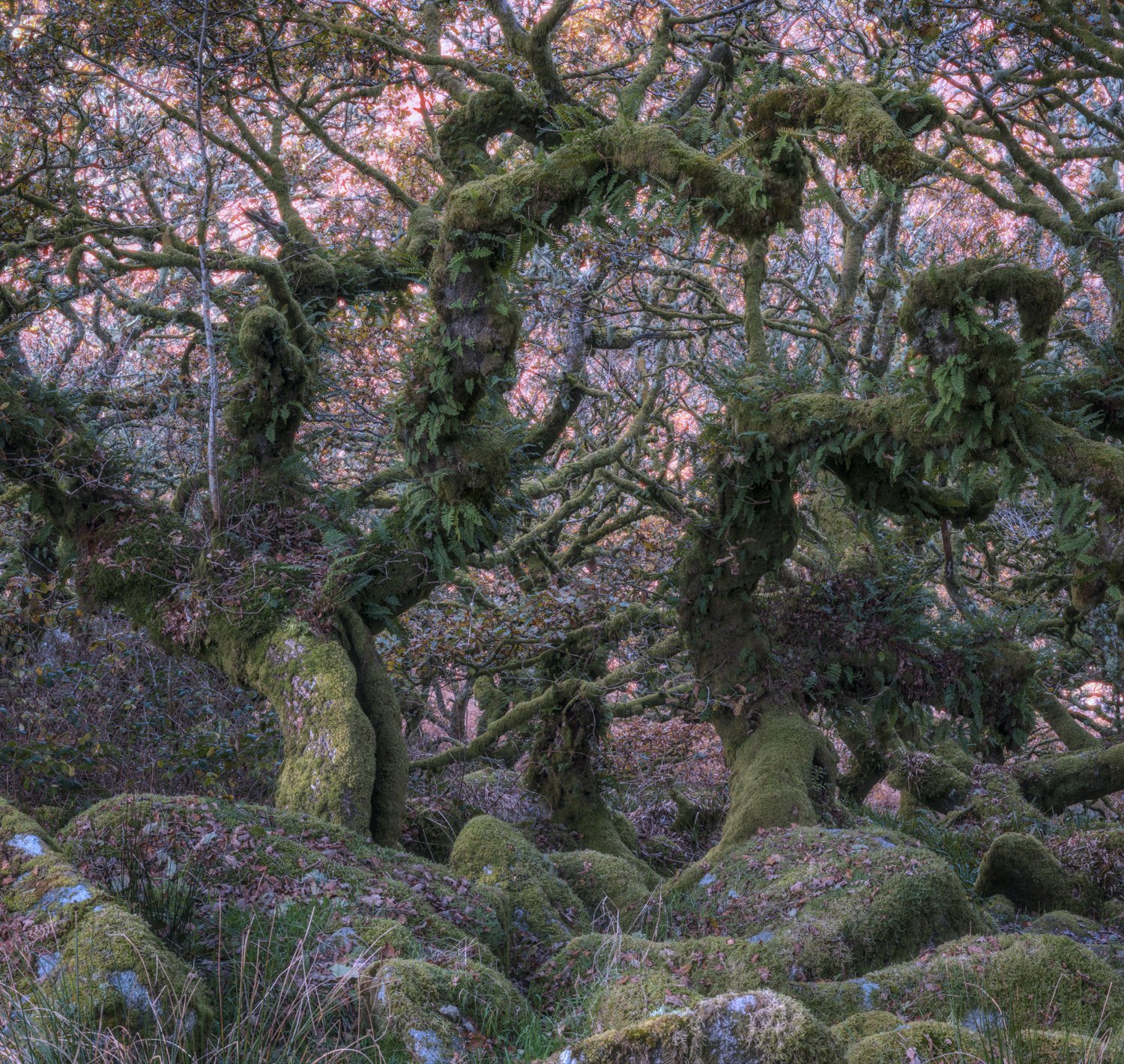
At Wistman's Wood, I was deliberately looking for compositions where branches, leaves and background elements blended together.
I wanted to explore the chaos rather than necessarily eliminate it.
The twisted oaks lend themselves particularly well to this approach. Their branches move in so many different directions that it can be difficult to distinguish where one tree ends and another begins.
Add moss-covered boulders, hanging lichen and autumn leaves, and the scene becomes a complicated arrangement of shapes and colours.
I find that visually fascinating.
Rather than looking for a single dominant tree, I was often looking at how the different elements interacted across the frame.
A branch might lead towards a patch of yellow leaves, while a darker area of moss-covered rock provided a contrast beneath it. Elsewhere, the hanging lichen created delicate textures against the heavier shapes of the trees.
The challenge was finding arrangements that felt interesting without becoming completely overwhelming.
I don't think every woodland photograph needs an obvious focal point. Sometimes the relationships between the different elements are enough to hold my attention.
There's something almost abstract about these compositions, particularly when the individual branches and leaves begin to merge into larger patterns.
It's an approach I find myself increasingly drawn towards, especially in woodland where there's so much visual information to explore.
Autumn Colour and Old Man's Beard
Although the sunshine wasn't what I'd hoped for, the autumn colours were particularly good.
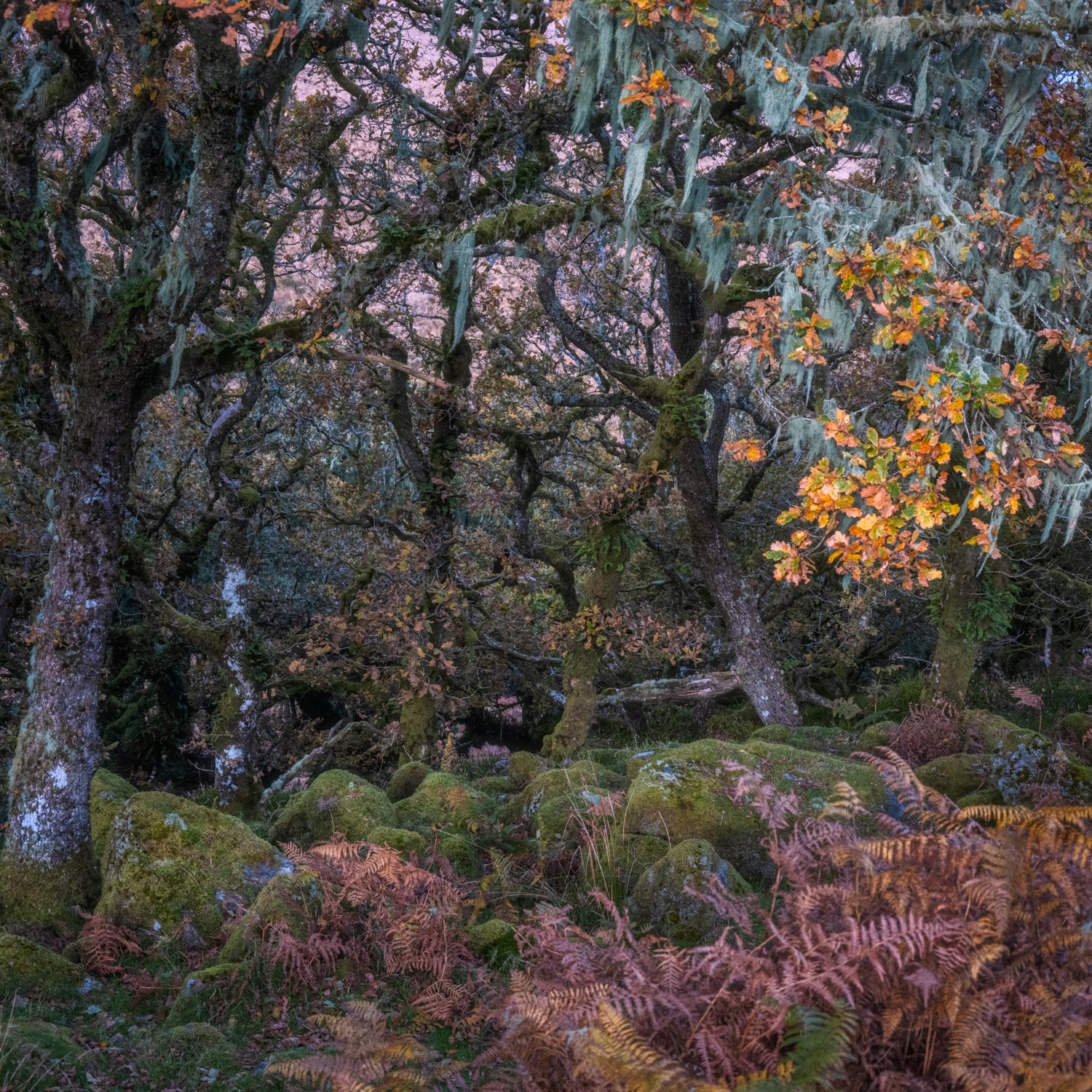
The yellow leaves were wonderfully vibrant, especially when illuminated by the softer sunlight. Against the deep greens of the moss and darker branches, they provided some striking contrasts.
The hanging lichen, commonly known as old man's beard, was another highlight.
There were places where it caught the light beautifully, its fine strands appearing almost luminous against the darker woodland.
It's one of those details that contributes enormously to the character of Wistman's Wood.
Combined with the twisted branches and moss-covered rocks, it gives the woodland a sense of age and texture that I find particularly appealing.
I was also struck by how well the colours worked together.
The rich greens of the moss, the yellow autumn leaves and the more subdued tones of the trees created a palette that was both vibrant and natural.
I haven't enhanced those colours in Lightroom. They are very much as I remember seeing them.
I think the combination of good autumn colour and bright but diffused sunlight was responsible for much of that vibrancy.
When the sun was shining directly into the woodland, the contrast could be rather unpleasant. But when it moved behind a cloud, the colours seemed to come together.
The greens retained their richness without the distracting highlights, and the yellow leaves provided just enough contrast to bring the compositions to life.
It's probably the most colourful I've seen Wistman's Wood on any of my visits.
And it has certainly made me wonder what the woodland might look like with those same autumn colours and a little mist drifting between the trees.
Perhaps one day I'll find out.
Camera Equipment and Exposure Settings
For this visit, I used my Fujifilm GFX100S II with the GF 35–70mm lens.
It's a combination I particularly enjoy using for woodland photography. The zoom gives me enough flexibility to refine compositions without constantly changing lenses, while the resolution of the GFX allows me to explore different aspect ratios.
I also used a circular polarising filter.
The polariser helped reduce reflections from some of the moss-covered surfaces and foliage, allowing the greens to appear richer.
With so much moss, lichen and vegetation in the woodland, I found it particularly useful.
I experimented with different crop ratios depending on the composition. I don't think every scene naturally suits the same format, and I enjoy having the freedom to change the proportions of the frame.
Some arrangements worked better in a more conventional format, while others benefited from something wider.
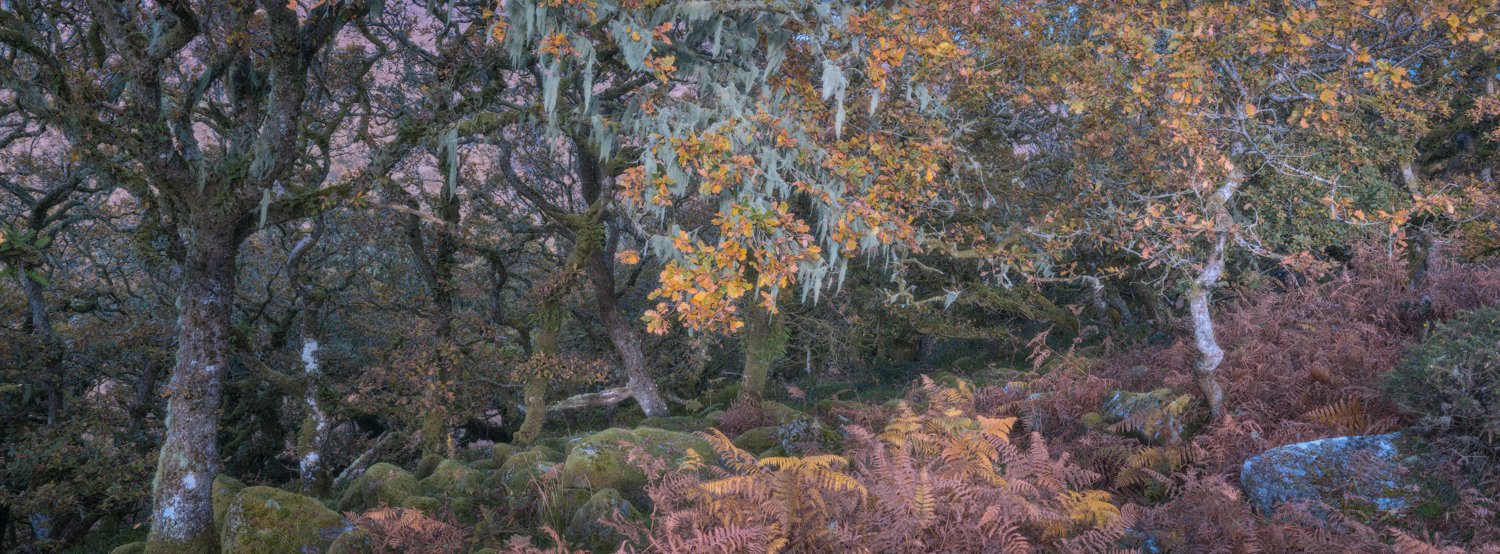
The panoramic photograph is probably my favourite from the morning.
What appeals to me is the almost equal division between the deep green areas of woodland and the vibrant yellow foliage.
The two colours seem to balance one another across the frame, while the twisted branches and hanging lichen provide the structure and texture.
It's a fairly complicated scene, but I think the colour relationships help hold everything together.
Although I used a tripod for every photograph, the wind introduced another technical challenge.
There was enough movement in the leaves that I needed to be conscious of shutter speed.
I was generally working between f/11 and f/18, wanting sufficient depth of field to retain detail throughout the compositions.
However, using smaller apertures meant I needed to increase the ISO to maintain a shutter speed fast enough to avoid blurred leaves.
Consequently, I was working at ISO settings between 400 and 1000.
It's a compromise that's sometimes necessary with woodland photography.
A tripod keeps the camera steady, but it does nothing to prevent leaves and branches from moving in the wind.
While a little movement can sometimes work beautifully in a photograph, it wasn't what I wanted for these particular images. I was interested in retaining the detail of the branches, moss and autumn foliage.
The combination of changing light and moving leaves meant that timing each exposure became particularly important.
Fortunately, the GFX handles those ISO settings comfortably, and I was happy to make that compromise rather than risk unwanted movement.
A Different Side of Wistman's Wood
By the time I finished photographing at around 9:30, I'd spent roughly two and a half hours exploring compositions from the upper edge of the woodland.
It had been quite different from the morning I'd imagined.
There had been no mist, no drizzle and none of the damp, atmospheric conditions I'd been hoping for.
Instead, I'd spent much of the morning waiting for clouds to soften the sunshine, experimenting with different compositions and enjoying some particularly beautiful autumn colours.
I wasn't surprised by the photographs when I reviewed them at home. I'd been able to see the potential in the compositions while I was there, particularly during those moments when the light became softer.
But I was pleased with what I'd managed to capture.
The panoramic image remains my favourite, largely because of the balance between the deep greens and vibrant yellows.
I also enjoyed the more complicated compositions, where branches, leaves and moss-covered rocks seem to blend into one another.
Photographing downhill rather than uphill had opened up some different possibilities, and it's something I'll certainly consider on future visits.
I haven't changed my mind about wanting to photograph Wistman's Wood in mist.
If anything, seeing those autumn colours has made me even more enthusiastic about the possibility. I can imagine how wonderful the twisted oaks, hanging lichen and yellow leaves might look with a little bright mist drifting through the woodland.
But I've also been reminded that conditions don't always need to match our expectations to produce worthwhile photographs.
Sometimes the weather forces us to work a little harder, to spend longer looking and to consider compositions we might otherwise have overlooked.
After packing away the camera, it was time to head into Princetown for breakfast.
Not quite the misty morning I'd hoped for, but certainly a worthwhile visit.
And I suspect it won't be too long before I return.
0 Comments